Page 20 of 45

Allen Fly Fishing: Compass 4 wt rod

My friend and recently-turned-neighbor, Evan Burck, works for Allen Fly Fishing. Allen has been around for a few years, but they’re not perhaps a household name in the fly fishing industry just yet. Here’s a bit about the company:

Allen Fly Fishing was founded in 2008 just as the American economy was taking a turn for the worse. Our founder branched away from his family’s plastics molding company using his contacts and expertise to found a new business specializing in fly fishing reels and hooks.

After more than a year of unforeseen popularity and growth, Evan Burck, a life-long angling enthusiast, joined the team and brought a fresh set of ideas to the company. As with any new business experiencing exponential growth and success, Allen has faced and overcome numerous trials and growing pains. The result is a company that truly values its customers, its products, and the experiences that we all enjoy on and off the water.

Read more HERE.

As I mentioned, Evan recently became my neighbor. He doesn’t live next door, or even just down the street, but he does live in the same small town and therefore is my neighbor.  While recently enjoying a bit of lunch at the local Armadillo Barbeque, Even gave me a new product to take for a spin: The Allen Compass fly rod. This one happens to be an 8’6″ 4 wt.  The 4 weight is my go-to trout rod for most of my trout chasing; I only dig out  my 6 weight when the wind is really howling and/or I need to throw big streamers. Other than that I fish my 4 weight. I find the 4 to be small enough to be enjoyable on sub-ten inch fish, but with enough backbone to fight any trout I am likely to encounter up to 20+ inches. The latter happens very, very seldom unfortunately.

I will say that the first thing I noticed about the new Compass rod by Allen is the color. It’s a shade of steel-ish blue that’s not typically what you’d expect to find on a fly rod blank. If you were to pick a color from a Hexidecimal Color Chart, the color would be very, very close to #6688AA, and that’s because that is exactly how Evan selected the color for this rod. Personally, I rather like it. Your opinion may or may not vary.

The second thing I noticed is that the 4 weight Compass is very light in the hand. Specs reveal that it weighs a mere 3.17 ounces, meaning you’ll be able to cast this rod all day long with nary an acknowledgement of fatigue.

I wasn’t able to fish the rod all day long, but in my defense it had nothing to do with fatigue. You see, winter in the Pacific NW simply isn’t the troutiest time of the year. I did, however, spend some time lawn casting the Compass and while not a single Lawn Trout was caught, the rod did reveal itself to be a nice-casting stick.  The Allen website describes the Compass as a medium-fast action rod that is capable of a wide variety of line types and fishing conditions. I had the rod matched with my first generation Ross Evolution 1.5 reel and Airflo Ridge Supple Tactical Trout WF 4F line. I was able to easily lay out casts as far as I would need to cast a 4 weight rod. The action of the Compass felt good to me; I tend toward fast action graphite rods but didn’t need to make any adjustments to my casting stroke when waving the Compass back and forth. I liked it.

I’m certainly no expert, but as for fit and finish the wraps appear to be perfectly done; the guides and reel seat nicely finished. The cork grip has a fair amount of filler, but I reckon that’s to be expected on any rod costing less than many hundreds of dollars. Unless I’m missing out on something, the Compass could easily be priced much higher than the $99 price tag that it carries. Then again, maybe the cost has nothing to do with the quality of the rod, but the philosophy of the company that wants to offer quality fly fishing gear without breaking the bank.

My personal conclusion: The Allen Compass is a cool-looking blank. It feels nimble and svelt in the hand. I can’t imagine it it gives up much in comparison to rods costing several times as much, and I think we’re going to be hearing more about Allen Fly Fishing in the years to come. I know I probably will be, because Evan is my neighbor.

Disclaimer: I was provided the rod to test and return to Allen Fly Fishing upon completion. If I did not like the rod I would have either said as much or opted not to review the product.


Winter Fly Fishing Body Condom

“Hope you enjoy the entire fly fishing season with these insulated rubber fishing waders.”

Don’t ask me how I found THIS eBay listing. I stumbled upon it while honestly looking for something else. Something else very important, I think.

Whatever the case may be, discovering this beauty made my day.  The bummer is that international shipping from Australia would make this purchase cost prohibitive, so unfortunately I will not be the envy of all Pacific Northwest steelhead fly anglers this winter. Damnit.

I’m concerned that the eBay listing will expire before many get a chance to marvel at the potential this item as a winter steelhead fishing outfit, so I have captured some of the photos and captions to share with you.

Please enjoy, and remember: you can customize this suit with enforced groin.

A flattering fit for all body types.

Breathable!

No felt soles to transport invasives!

Integrated gloves for ease of line handling.

Sage One 7136: A Hack Casters Thoughts

Commence jubilation.

A particular parcel arrived the day before leaving for a recent steelhead trip on the Clearwater River in Idaho: a long, cardboard tube with a return address on Bainbridge Island, WA. That could only mean one thing—the Sage ONE 7136 had arrived.

Let’s be clear that this rod was not mine to keep and covet; I was merely sent the demo rod to take for a test spin. Still, I was quite delighted with its arrival and was particularly eager to see what this rod was all about. I don’t own any rods from the ONE lineup, but I’d tested a single-handed version of the ONE a year earlier and rather liked it, a lot. That was the Sage ONE 486-4, which I compared to my own Sage Z-Axis 490-4 (the ONE replaces the Z-Axis line of rods). If so inclined you can read my review HERE, but we’re gathered today to discuss a two-handed rod from the ONE family tree, so let’s proceed.

Sage introduced the ONE line of two-handed models well after launching the single-handed rods, and for good reason. The two-handed Z-Axis rods were incredibly popular and continued to sell well; no sense rushing a new rod to market given the vast success of its predecessor. Of the Z-Axis two-handed rod family, the 7136 in particular enjoyed a sizable following (myself included). I am not a great caster by any means, but I do know the Z-Axis 7136 has done it’s fair share of ensuring I don’t completely suck. With all the love out there for the Z-Axis, the ONE 7136 had some big tubes to fill.

Right out of the black powder-coated tube the ONE grabbed my attention: Shiny and black with bronze accented wraps and down-locking reel seat that make for a very attractive stick. The cork was a little clean for my liking, but then again the rod was unused so I can’t consider this a fault of the rod itself. Sure, it’s pretty, but what’s an old saying about putting lipstick on a pig? If the rod wasn’t any good, it wouldn’t matter what it looked like. Surely once we got to the river the ONE would be more disappointed in me than vice versa.

One is heavier than the other.

The second thing I noticed is that the ONE 7136 feels very light in the hand. Mind you I’ve never felt fatigued after fishing my Z-Axis 7136 (7-1/8 oz), but by comparison the ONE (7-5/8 oz) felt lighter. The strange thing is that according to Sage, the ONE is actually heavier than the Z-Axis by 4/8 of an ounce (for those mathematically inclined, that equates to 1/2 ounce). One half of an ounce spread out over the length of 13’6″ really isn’t much—and could be considered negligible—but for those counting ounces it’s worth noting. The blank is thinner on the ONE than the Z-Axis and the foreward grip is 3 inches longer. Could be that the balance point of the rod makes it feel so light and with a reel mounted, the down-locking seat places the reel farther back. The Z-Axis has an up-locking seat; another difference.

More cork, feels lighter.

Another thing that may perhaps make the ONE feel so light is that there is less movement. As far as action and feel, the ONE is much stiffer. It’s certainly not a broomstick because the forward third of the rod does have plenty of flex and sensitivity, but it doesn’t flex nearly as far down the blank as the Z-Axis. I would definitely call the ONE a fast action rod. Conversely, while many of the Z-Axis models were billed as fast action, I never considered the 7136 fast by any means. It’s certainly nothing of a noodle, but it does have considerable flex down the blank. Nutshell: there’s a lot more wiggle to the Z-Axis than the ONE, both up-and-down and side-to-side. This is particularly noticeable when casting the rods: the ONE stays on track and punches the line in a very straight path, despite what poor casting may have attempted to otherwise accomplish. I believe that’s the Konnetic Energy at play, which reduces lateral movement. So, did I cast any better with the ONE than with the Z-Axis?  Not necessarily, but in defense of the ONE I don’t believe I had the best line for the job.

I didn’t consult any experts on what might be the best lines for this rod, but instead took what I had for my Z-Axis, figuring that this was going to be an apples-to-apples comparison. The lines I use on the Z are a 480 grain Airflo Compact Scandi with a poly-leader for summer fishing, and a 510 Airflo Compact Skagit for throwing sink tips during the winter. For my trip to the Clearwater River where I tested the ONE, I was using only the Compact Scandi due to low water conditions.  I was able to get the casts out to the best of my abilities (which are limited) but I felt as though the 480 grain line wasn’t quite enough to load the rod. Individual casting strokes and abilities may have a lot to do with this because if you jump over to The Gorge Fly Shop and read their review of the ONE 7136, their opinion is that the 480 grain line is too heavy. If you’ve entered into the two-handed game you know that matching a line to a rod is nowhere near as simple as it is in the relm of single-handed rods. You say yes, I say no; that sorta thing. I’ve no doubt the folks at the Gorge Fly Shop are a much better authority on the matter, so please disregard whatever I say here about it.

While casting, the ONE felt very powerful, nimble and efficient (even if I didn’t feel as though I was getting the rod fully loaded). The casts went where they were supposed to go and the rod recovered quickly: very little shimmyin’ and shakin’ in the blank. I would have loved to have played a steelhead on this rod, but over the course of 3 days fishing I only managed to swing up an 11″ whitefish. To my credit, I don’t believe many anglers have swung up a whitefish. I fished the ONE for two days, then went back to my Z-Axis on the third. It was like seeing an old friend and I immediately felt comfortable. But I did notice that there was considerably more overall movement in the Z than with the ONE. Call it what you will, with the ONE I felt more connected to the rod, with fewer distractions caused by excess movement of the rod during the casting stroke. I’ll say it again: I love my Z-Axis 7136. But I can see myself falling for the ONE, especially after I spend more time with it and/or find the line that works best for me.

And that has me worried, because in the words of Junior Albacore, who took a few test casts with the ONE, “Oh yeah.”

Two weeks later I had occasion to fish the ONE again, this time on a different river. Temperatures had dropped considerably, bringing snow to the mountains and lowering river temps accordingly. This trip would be a sink tip game so I strung up the ONE with my 510 Compact Skagit and a type III sink tip and gave it a go.  I liked the results, a lot. With the heavier grain Skagit head and added weight of the sink tip, I felt the ONE loaded well and slung the load very nicely. “Smooth” comes to mind. Normally when using this line on my Z-Axis it feels a bit “clunky”, to use a technical term. This time around the ONE really seemed to come alive while casting, and while I hoped to see how the rod would feel while fighting a fish, it was not to be. In my vast (insert sarcasm here) experience fishing for steelhead in the Pacific NW, it’s really much more about casting practice than catching fish. If you’re going to spend that amount of time casting a rod and not catching fish, you really want to enjoy the rod in your hands. Suffice it to say the Sage ONE 7136 is one sweet practice rod.

I’d recommend trying out several different lines before buying a line (or two).  Visit your local shop. Borrow a few different lines. Find the one that works for your ONE. If your local shop doesn’t have a program for demoing lines, call Poppy at The Red Shed. He’ll hook you up with a few lines to test drive. Note that Poppy likes a 450 Compact Scandi for this rod, and says that a 510 Compact Skagit or a 525 Rio Flight are also great. Poppy is the guy to talk to about Spey casting so give him a shout or email him.

Unable to fish with cane.

Front Matter/Back Story:  Jason Zicha, master rod builder at Fall River Fly Rods, fashioned a custom bamboo rod especially for a promotional tour courtesy of the Outdoor Blogger Network. Accompanying the rod is a Madison II Reel by Montana Fly Company spooled with a Trout LT DT5F fly line by Rio. Fifteen blogger/anglers were chosen to spend a couple of weeks each with the outfit before passing it along to the next person. After a cross country trip that will have endured more than half a year, the outfit will conclude its journey by permanently going home with one lucky angler/blogger.  I was one of the fortunate folks chosen to spend time with this outfit during its journey.

I knew it was coming as far back as last April. I knew it wouldn’t be getting to me until Fall, hopefully in time for some Autumn baetis action on the Yakima River. Fall River Fly Rods, aptly named it would seem. I envisioned myself presenting tiny mayfly patterns to wary fish. Delicate delivery would be the ticket, and armed with a custom bamboo fly rod I would be up to the task, or at least the rod would be.

As the months droned on I grew increasingly Worried (yes, with a capital W). Having a last name that begins with the letter “W” I’m no stranger to being at the end of the list: all during my school years I got one of the last picks of a desk in the classroom (which usually meant right by the teacher’s desk); when it came time for class registration I got the leftovers. Nor am I unaccustomed to being one of the last ones chosen during kickball team selection, but that had little to do with alphabetical order. This time, however, I cannot blame my forefathers because the schedule for this travelling rod was not based on last names. I thought per chance the schedule was based on the alphabetical listing of the host states because, after all, the first visit along its journey took the rod to Arizona. But then it skipped ahead to New Mexico so that blows my theory out of the water. All I know is that the package didn’t arrive at my home in Washington until November and unfortunately that was too late for me. Certainly there are still trout fishermen out plying the frigid waters this time of year, but with no available weekends until after Thanksgiving I simply ran out of time. The rod was on a schedule: it had places to go; people to see.

And so here this beautiful rod arrives after all these months of waiting and anticipating, and because of bad timing I don’t even get to fish it. I reckon this was my destiny—the ultimate angling unaccomplishment.

The Bazooka.

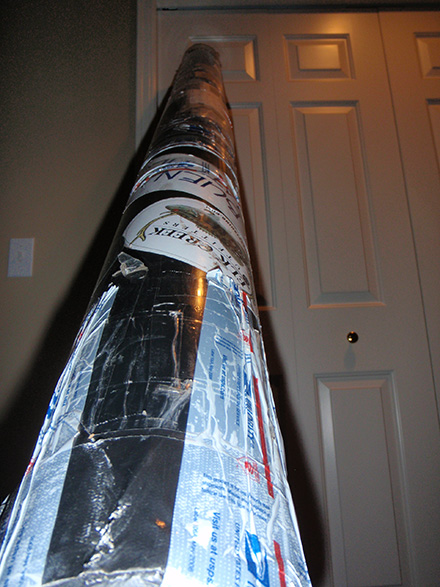
Knowing that I would not be able to give this rod its due, I gave it what I was able. I sat with it, fondling and admiring the rod. The experience began with the shipping tube, which resembled the barrel of a bazooka in both size and weight. This monstrous PVC fortress was created with protection in mind and for good reason: inside were valuable contents. More than just a shipping tube, the Bazooka itself tells the story of cross-country travel as it was slathered with stickers of all sorts, and enough Priority Mail tape to span from one coast to the next, from border to border. Following directions, I opened the end labeled, “Open This End.” It took me a while to cut through all the clear tape.

The goods.

The first item to emerge was a small aluminum box containing a few flies that the blogger/anglers had donated. I contributed to the collection but won’t tell you what I offered up (it wouldn’t earn me any respect or gratitude). Next up was the neoprene pouch containing the Madison II reel from Montana Fly Company, emblazoned in their river rock pattern. Last to emerge was a hand-made oak case containing the rod (the case is a functional work of art in and of itself). Once I had extracted the goods, I got down to the business of looking at it. In a discussion over at the Facebook place, Poppy Cummins of the Red Shed Fly Shop was quoted as saying:

“Playing with cane is like looking over the back fence at the naked neighbor lady. Once you start you can’t stop.”

The naked neighbor lady.

I will say that over the next week and a half I did an awful lot of looking, and it was hard to divert my gaze. Though I enjoyed the scenery, guilt gnawed at my gut, slowly eating away at me. The burning in my belly was a reminder that as beautiful as it is, this is a rod to be used; not just ogled over. I wished like hell I could have fished it. I read through the journal that accompanied the outfit along it’s journey: no one else prior to me had mentioned not fishing the rod.

I know next to nothing about bamboo rods. In my ignorance I always assumed all were delicate, flimsy noodles: either antique collector’s items or modern showpieces. But the rod’s designer states very clearly that this rod is not your grandfather’s bamboo rod, and I will echo that sentiment. I have an old bamboo rod that belonged to my grandfather and it would be accurate to describe it as a whispy piece of grass. I’ve never fished it; never wanted to after wiggling it—I mean, who has 5 minutes to wait between forward and back casts? I do remember a tip my grandfather gave me many years ago which I was prepared to employ with the Fall River rod until I read the directions from Jason Zicha that were included in the Bazooka: “Do not apply any oil or nose grease to the ferrule.” So much for my grandfather’s advice.

Don’t take my grandfather’s advice.

After a lengthy lawn casting session with the Fall River rod (during which I did not rise a single Lawn Trout), I can tell you that it is no limp-wristed wussy. It does have ample flex, but it is not a slow-action rod.  I was able to quickly adapt to the rod’s action and get casts out to around 40 feet with ease. I was surprised, and then I read the description of the South Fork on the Fall River website:

“The South Fork model was designed with a new generation of anglers in mind.  It’s moderate/fast action has a more familiar feel to today’s modern angler who has grown accustomed to the feel of graphite fly rods.  8’ in length, it’s powerful spine has the power needed to fish our large, open, windy Western Rivers.  The smooth action has been refined to throw anything from a midge to streamers.”

“South Fork” Outdoor Blogger Network 2012

With the delicate tip—not delicate so much in construction but rather in feel—I could unfold a cast and lay the tippet onto the grass with a certain finesse that is difficult with my graphite rods. In the time I spent on the lawn with the rod, I did notice that it’s heavier than my graphite sticks, but that’s to be expected. The action of the rod felt remarkably familiar and was not what I expected. I’ve become so accustomed to the uber-light, nimble ways of my fast-action arsenal of graphite rods that I’ve also become disconnected to the casting experience that only slowing down can bring back. Getting into the slower rhythm of this rod had a sort of soothing effect— even if I was standing in my front yard as school buses drove past and the neighbor’s dog barked from behind its fence. A bubbling mountain stream would have been a more suitable setting in which to cast this rod. A suburban lawn just seemed wrong—an injustice. Again, my destiny.

A work of art.

The nickel silver stripping guide is inlayed with a natural agate that is saw-cut, drilled, polished and then set into the frame. Fall River Fly Rods buys these pre-made, because as Jason Zicha says, “It is an art form of its own.” Everything about this rod is beautiful in it’s craftsmanship, but it’s no showboat. Again, the South Fork is built to fish.

I begrudgingly place the rod, reel and box of flies into the shipping tube and sealed it closed with a pound of strapping tape. I slapped on an Unaccomplished Angler sticker and drove to the post office. Next destination, Spokane WA. I hope Josh Mills has an opportunity to fish it. I know the weather in Spokane is colder than it is on my side of the state and trout fishing may be a bit out of season.

If the rod could speak, its parting words for me would surely have been, “Good riddance.”


A Deliberate Life

During this past summer of my discontent, I wrote of plans cancelled, dreams dashed, accomplishments unaccomplished. Of the several things I missed out on, missing out on one event in particular still haunts me. I was invited to partake of a very special opportunity not only to fish with a bunch of great folks who I’ve wanted to meet in person for a long time, but to witness the filming of  A Deliberate Life, a film being produced by Matt Smythe and Grant Taylor.

Despite my lack of attendance somehow the folks who were there managed to have a great time and the crew captured some incredible film. And in the time since then they’ve been very busy in the editing room, matching the footage to an introspective narrative that touches the soul. Just released is the official trailer for A Deliberate Life, which has been selected as a feature film for the 2013 International Fly Fishing Film Festival. I cannot wait to see the entire film, but I’ll have to wait until sometime next Spring to do so.  Check the IF4 schedule to see when the show rolls into a town near you—2013 dates don’t appear to have been posted yet.

Set primarily against the diverse, rugged and breathtaking landscape of Idaho and Oregon, A Deliberate Life explores the stories of five unlikely friends who share the same love of fly fishing and the outdoors and their choice to lead a life according to their passions.

Read more about A Deliberate Life—the project and the people behind it—here: Silo4

How short is your rod?

“Did you order more fishing crap?” called out the very supportive Mrs. UA when recently an anonymous gift arrived by one of my favorite brown delivery vans.

Honestly I had not, and I admitted as much. I had no idea what it might be: the box wasn’t long enough to be a fly rod, nor was it small enough to be a reel. I was perplexed. Upon opening said box I was still perplexed, for inside was a short plastic tube containing what appeared to be a two-piece fly rod from Redington. A very short, two-piece fly rod (insert short rod jokes here; get it out of your system now).

Longer than the inseam on my Redington Sonic Pro waders, but not much.

Called the “Form”, this diminutive stick is just 50 inches long. Unlike many who exaggerate the length of their rods, Redington actually tells it like it is, although truth be told the Form may even be a just a tad longer than 50 inches. Kudos to Redington for their conservative honesty and self-confidence.

Tale of the tape.

As one might expect from a rod this size, it has a proportionately small cork grip (a mere 6.5″ long) and just 4 snake eye guides (there is no stripping guide). Like other Redington sticks, the Form has alignment dots to help ensure the sections are placed together properly (I wish all rods had alignment dots). It looks just like a small fly rod, except for the lack of a reel seat.

There’s a fly line and a strike indicator, too.

It even comes with a 30-foot length of specialty Rio fly line with a very thin tapered tip. Tied to the tip of the line is a chunk of orange yarn, which may or may not be a strike indicator.

I will say that despite what it lacks in size the Form makes up for with good looks and castability: the one I received sports a handsome, crimson-colored blank (Redington also offers it in blue); the reliable old wiggle test suggests that it’s a slow to medium action rod; you can feel it load down to the cork but it recovers nicely. As for line weight, I’m not sure what it’s rated for because the blank isn’t stamped with a numerical designation. I’m going to go out on a limb here and suggest it’s probably not a steelhead rod.

I was curious to learn more so I jumped online to Redington’s website to see what the Form was all about. Turns out it’s not really a working fly rod, but rather a “game play” tool designed for having a little fun off the water. However, just a toy the Redington Form is not: it can be used to practice your  casting and improve your form. It could also be a great tool to help beginners and youngsters develop their casting stroke, so keep all that in mind when you’re shopping for your favorite angler this Christmas.

This informational video does a better job of explaining things than I could ever hope to do. What it doesn’t tell you is that the Form costs only 79 cents per inch (that’s just a tidbit of data I calculated—no charge for that).

I suppose the lack of a reel seat should have been an early indication that this was not an actual rod to be used for fishing, because anyone who’s anyone knows that you do not go angling without a reel. That would just be ridiculous.

Then again, perhaps this is Redington’s entry into the Tenkara market.


A kinder, gentler, Rugged Eddie Bauer Man

Most fly anglers I know are not casual about their passion for the sport activity: it’s an obsession, or at least it becomes one after a period of time. Be it for better or worse fly fishing eventually consumes them as it becomes woven into the very fabric of their lives, and for those with OCD tendencies, channeling that intensity and restlessness into a productive* activity is paramount to maintaining sanity. To that end fly fishing calms the beast within. (* Nobody ever said fly fishing was productive)

I need something more…

Let’s take one particular individual for example: Rugged Eddie Bauer Man.  We first met him over a year ago, HERE. The man we encountered was intense and stern; humorless. His all-business expression suggested that he was carrying the weight of the world on his shoulders as he dabbled in a variety of meaningless activities, seeking to squelch the fire that burned in his belly. Neither climbing the masts of sailboats, toting large cargo nets nor carrying heavy rope could provide the escape he needed from a cruel reality. These empty endeavors did not speak to him; nothing satisfied his thirst for more. When we left him last he was deep in contemplation, wondering perhaps, “What else is there?”

A year later, we caught up with Rugged Eddie Bauer Man. The first thing we noticed was that he seemed somehow…different; the powerful jaw, while still prominent, was no longer clenched intensely.

He definitely seemed more relaxed; more at peace with himself and the fast-paced world around him. The smile appeared genuine; not contrived.


No longer fiercely comptetitive, Rugged Eddie Bauer Man had become the guy who would  reach out with a fingerless wool glove-clad hand and help a brother cross the street as opposed to throwing him under the bus.


He appeared, for all intents and purposes (not intensive purposes), to have become the guy who would engage you in a friendly conversation and perhaps even tell a good joke, or at least laugh at one. Warm hands, warm heart.


Rugged Eddie Bauer Man seemed to be less about work and more about play.  He appeared to have embraced recreation for the pure enjoyment of it, rather than as a means of competing against and dominating others.


Sure, there were moments when Rugged Eddie Bauer Man would lapse into images of his former self, but these moments were short-lived. And cut a guy some slack—he’s not perfect. But he is obviously making a concerted effort to not take things so seriously.


Like an addict in recovery, at times Rugged Eddie Bauer Man seemed troubled by his serious past and would give pause to ponder where he had been just a year earlier. During these episodes we step back and give him space while at the same time letting him know we are there for him; rooting him on:  “You can do it, Rugged Eddie Bauer Man—resist the darkness…lighten up.”


Fortunately that steely resolve which made him so intense also served to bring him back around and it wasn’t long before the muscles in his face and neck had relaxed once again. Maybe it was the new corduroy blazer that made him happy again; whatever the case may be, the lighter side won out. Rugged Eddie Bauer Man had fully embraced the notion that it takes fewer muscles to smile than it does to frown.


And he got himself a dog. Dogs are good for people. It’s been proven that man’s best friends have a calming effect, and Rugged Eddier Bauer Man’s best friend certainly brought out the best in his master. The former Rugged Eddie Bauer Man wouldn’t have been caught dead wearing a cardigan sweater. Time changes a man. Fred Rogers, rest in peace, would be proud.

So what was the cause for this transformation? Had Rugged Eddie Bauer Man taken sensitivity training? Did he have a an epiphany? Perhaps a brush with death that made him appreciate life? Or had that intensity simply been channeled productively** into an activity that tempered his fiery soul? The transformation was remarkable. One can only conclude that Rugged Eddie Bauer Man had found fly fishing.(** Again, nobody ever said fly fishing was productive)

Welcome to the club, Rugged Eddie Bauer Man. Let’s go wet a line, brother.


Trifecta of Smokin’ Hot Fly Fishing Babes V

Trifecta of smokin’ hot fly fishing women

Ironically one month ago to the day I posted the above photo of 3 fly fishermen who just happen to be ladies. If you missed it, then you are in the minority because thanks to all the Neanderthals out there in cyberspace who use search terms such as “hot fishing women” “women fishing in bikinis” and “sexy women in waders” my site had over one million visitors that day. I’m kidding, of course, but I did have 500 hits the day that post went public. Not a bad day at the office for this paltry little blog.

You’ll note the title of this entry bears the designation: V. Intuitively one might conclude that my original post would be considered I, as in Part I, right?  And if that’s the case then you may be asking yourself, “Hey, what happened to Parts II, III and IV?”

Ah, but therein lies the catch:  This is not Part V as in Part Five. The V stands for something other than that…

Little did I know that at the time of my entry those same three ladies were brewing up something big. That something is a new website which, while still in its infancy, looks sure to become a great resource for women in fly fishing. Personally I think it’s a brilliant idea and I wish I’d thought of it myself. Admittedly it’s best that I didn’t, however, because I lack a woman’s…intuition.

For women interested in fly fishing or those already immersed in the sport, there’ll be something for all: stories from the water, interviews, gear highlights from the industry, fly tying and entomology, photos from the field, and so much more…all wrapped up in “an interactive, informative, and comfy place for women who fly fish.” Sounds rather welcoming to me—wonder if they’ll serve chocolate? Sorry.

So, what does V stand for?  I’m sure you Neanderthals have guesses and I assure you that you’re wrong. No doubt the answer lies somewhere on their new website:  flyfishingv.com.

Trifecta of smokin’ hot fly fishing Valkyries?


Best of success to Aileen, Rachel and Rebecca. Check out their new site, visit them on Facebook and follow them on Twitter.

Down by the River

That was then. This was now.

The last time I heeded the call to join Large Albacore on the Methow, we had the entire river all to ourselves and still caught no fish. Of course, that was then. This was now. This time would be different, and it was.

A dusting of early season Coastal Concrete.

An hour after departing home at 4:30 I ascended Stevens Pass (elevation 4,062 ft) on my 2.5 hour drive to Albacore’s home. An early cold snap had turned the higher elevations white with the first dusting of wet snow, and while it wasn’t a whiteout by any means, there was an inch of sloppy stuff on the highway. This is not your fluffy inland powder, but rather a product of considerable coastal moisture: slippery goo that turns to chunky ice when the temperature dips below freezing. I was glad for good tires and 4 wheel drive so that I could pass the white knucklers doing 35mph in their rear-wheel drive sedans. Early season snowfall always catches a few people off guard—the same people each year.

The snow intensified for a period of time as I crested the summit and I couldn’t help but have a feeling of Deja-Vu. Two years earlier I’d made this same jaunt and the snow that began to fall during that trip never let up. In fact that storm would be the beginning of a winter that seemed to drone on forever. This time, however, the snow gave way to rain. Winter wasn’t ready to take over just yet and there would be no repeat of two years earlier, at least as far as the weather was concerned.

Old Young.

After a late dinner, Albacore and I retired to his basement where we watched a documentary film about Neil Young: Journeys. We’d both been fans of Neil since the days when Young was much younger and as we watched the film we remarked at how the old Neil still had the same velvety tone to his voice that he’s always been known for. Watching this film rekindled our love for the Godfather of Grunge and before we turned in for the night it was agreed that we would queue up some young Young while driving to the river the next morning. We didn’t have to wait long for that.

The alarm sounded at 4 AM and was followed immediately by a solid breakfast of eggs, hash browns and coffee that fueled our enthusiasm as we loaded Albacore’s truck and headed north. Live Rust emanated from the stereo and as we drove through the darkness we did our best Neil Young imitations. Suffice it to say that both Albacore and I have what it takes to be vocal stand-ins should Neil ever need us: we’re every bit as good as Jimmy Fallon. No, really—just ask either of us.

Singing has a way of making time pass quickly and before we’d even finished with the album it was 5:54 AM and we had reached our destination. The intent of our early arrival was to ensure that we got the run we wanted, which we did. We took our time gearing up before slowly picking our way along the dark trail. We waited Down by the River for another 20 minutes before it was light enough to fish.

Spey rods and Meat Poles

We each brandished two rods: a Spey rod and a single handed 8 weight Meat Pole. It was agreed that we’d work through the run twice with our two-handers before rigging the Meat Poles. Hopefully it wouldn’t come to that. Albacore fished the head of the run with his go-to “Blue Moon” pattern; one that he fishes regularly and with confidence. I dropped in below and began slinging a red and black marbou streamer, courtesy of Ross Slayton (check out his newly-launched blog, Should Be Fishin’).

Not long into the morning Albacore hooked up with and landed a beautiful hen which he wagered  was maybe 8 pounds. I suggested she was at least ten.  Due to great differences in height, our perspectives are vastly opposite and equally skewed. Whatever the case may be, this fish was definitely a better than average-sized steelhead for this particular river and the skunk was off. At least for one of us.

Albacore’s fine wild hen caught on the swing.

The only fish I’d seen was a big old Chinook salmon that was hanging out in the shallows near a large redd, his tail waving gently back and forth in the current. I gave pause to wonder what the old buck was thinking as he neared the end of his journey. He’d had a good long life and had returned to his natal stream after an impressive upstream trip through several dams on the Columbia River. Though his decaying body was gradually failing him, his eyesight remained keen as he watched me. He was none too shy and only moved out of my way when I got closer than 5 feet.

The Traveller.

After a second pass through the run without so much as a bump, Albacore instructed me to do the unthinkable: rig the Meat Pole. As he finished out the run I shamefully headed toward his gear bag and reached into the abyss for a box of dirty little secrets that was tucked away out of sight: nymphs. And stashed inside an even darker, hidden pocket: beads. Now, while there is nothing wrong with nymphing beads for steelhead if you want to catch steelhead, it is said that the noble way to go about catching steelhead is with a swung fly.  That being said, if there’s one thing worse than nymphing beads for steelhead, it’s not catching steelhead. I glanced over my shoulder to make sure no gentleman anglers were watching from the road above, rigged a black stonefly nymph and trailed a bead off the end. It was time to get dirty.

Out of the blue and into the black.

When one trades in their Spey rod for a Meat Pole, the transformation is remarkable. A Spey caster is a vision of serenity and self control; finesse and fluid beauty. Effortless sweeps of the long rod are poetry in motion and one can imagine the image set to the soothing sounds of Harvest Moon. A bead fisherman is a different animal. His face bears the grimace of a barbarian; yellow teeth clenched as tightly as their white knuckles on the cork. Involuntary guttural sounds are produced as the angler contorts his entire body with each crude stroke of the Meat Pole. Desperate casts lack form in favor of function as the nymph fisherman pounds the water in a manner that would best be accompanied by Hey Hey, My My. But not even playing dirty could produce a fish and so, fatigued and distraught at not having produced any fish even on the Meat Poles, we broke for lunch which Albacore had prepared the night before.

Would pickles be asking too much?

Sandwiches consisted of turkey, cheese and honey dijon mustard. Albacore apologized for the lack of garnishments, admitting that sliced pickles would have added a certain pizzazz to the otherwise lackluster sandwiches. We debated the sweet pickle vs. the dill, and it was decided that dill would have been the preferred choice. I didn’t complain and noted that it tasted great as it was. Albacore insisted that pickles would have been nice, but he worried that they would have just made the sandwiches soggy by the time we’d eaten them. I chewed on that for a minute before admitting that a pickle would have been nice, but not necessary. Sometimes the thoughts in my head manifest themselves into spoken words, not unlike Tourette Syndrome. Before I could stop myself I blurted that if he’d really cared, he would have taken care to slice some damn pickles and place them in a plastic bag so that we might apply them to our sandwiches, solving the matter of soggy bread. We ate the remainder of our lunch in awkward silence.

Like water under the bridge we put the pickle matter behind us and fished the next few hours in much the same way that we’d fished the morning. As a last resort we even revisited the first run of the day hoping to find another fish where Albacore had found his earlier. The run held no steelhead.

But the Traveller was still there. He hadn’t moved much. His tail seemed to flip more slowly but he still kept an eye on me so I thought it appropriate to sing him a little song. It helped pass the time.

Travel on, Old Man.


Not catching steelhead, Part II

Continued from…

When the going gets tough, the weak take naps (photo courtesy of Large Albacore)

Day 2: The morning was clear and cold, and while I’ve fished in much colder weather, I underestimated the coldness on this morning and left my gloves in the truck. I should have opted for a fleece stocking cap as well, but went instead with the Lucky Fishing hat. After standing in what is known as The Holy Waters for an hour, the shivers set in. My lower back, which had been tweaky for a couple of days, began to tighten up. Being cold and standing precariously on an assortment of large and slippery rocks didn’t help matters, and soon I began to have lower back spasms. I did what any hardcore steelhead fisherman would do: I toughed it out went back to the truck and fell asleep in the front seat. An hour later I was awakened by Large Albacore, who had nurturing words of compassion and support for me.

Large Albacore casts into the setting sun.

Suffice it to say the rest of the day improved inasmuch as the weather warmed and my back felt better. The catching, however, remained dismal. We drove up and down the river, seeking out any vacant water we could before determining that there were no fish to be caught. Still, it was a good day spent practice casting. I got to know the Sage One 7136 demo rod a bit better and came to appreciate it’s nimble ways and ample power. I determined that in the hands of a worthy caster the rod would really shine. As the sun set on another day and we headed back to the Pink House for another great dinner served up by Papa Albacore.

The smoke had hung more heavily in the air on this second day, an indication that the distant fires continued to burn. What the fires needed was rain, as did the river and the fish, and therefore the anglers.  Fortunately the weather forecast indicated that rain would arrive overnight, so with that knowledge I closed the tailgate and lift hatch on the Fish Taco’s canopy and wedged myself into the tight space within. Sometime during the night I awoke to the sound of rain drops on the fiberglass roof. The rhythmic pitter-patter of precipitation put me quickly back to sleep, though not before I acknowledged that 5-foot truck bed is a bit short even for an Unaccomplished Angler.

All the comforts of a 5-foot home.

Day 3: The alarm sounded as a light rain continued to fall. The air smelled fresh for the first time in a long time. It was a new day. A day filled with hope and anticipation. I rigged up my Z-Axis 7136 for this third and last day of fishing: I wanted to end the trip fishing my trusted old friend so that I could have a good sense of comparison between the old and new offerings from Sage. The Z-Axis had caught steelhead before—it deserved a chance to do so again. After breakfast we headed back to The Holy Waters. The day was warmer and the back felt better than 24 hours previously. There would be no limp-wristed timeouts on this morning. I was there to fish—nay, I was there to catch a steelhead.

Across the river stood a lone angler throwing laser loops with grace and ease. His casts were a thing of beauty, and I hoped he was paying no mind to the clunky casts being flung from the opposite river bank. Even with my trusted old Z-Axis, my best casts fall short of anything that might be described as graceful. I took a couple steps down, stripped line and executed a serviceable Snap Z (or was it a Snap C?); my fly flew lazily toward mid-current. As the fly swung there followed the familiar tap-tap-tap of a steelhead mouthing the hook. Remaining calm, I may or may not have yelled, “Sweet Mother of anadromous rainbow trouts!” I lay the tip of the rod toward shore as the fish swam the opposite direction, setting the hook in it’s tough lips. Fish on!  Ironically, at the same instant, the Jedi Caster across the river also had a fish on. What were the chances that I would hook up with a fish at the exact same time as my accomplished brethren on the far side of the Holy Water?

Line continued to be ripped from my reel as I dug my heels in for a good fight. This was it—what many anglers wait 1000 cast for. Just then a friendly and apologetic voice called out from across the river: “Sorry about that!”  A brief rush of adrenalin quickly faded with the realization that the only hook-up had been between our two flies. “Feed me more line and I’ll get us unhooked!” instructed The Jedi.  At least I saw my backing for the first time in a long time.


Double Trouble: hooked up with the Jedi.

After the fleeting, ill-fated excitement of the morning, we broke for lunch before heading downstream for the afternoon. The rain had given way to a pleasant, overcast day. We fished on, trying our best to remain hopeful with each new run. Admittedly, hope was a tall order and it was hard to ignore the presence of 1000-lb skunk that loomed overhead. I reminded myself that steelhead fishing is not about catching fish; it’s about casting practice. Still, it seemed particularly cruel that of the 5 anglers in our posse, not a single steelhead had been hooked. Fortunately that would change when Junior Albacore landed a nice 8 pound hen about midway through the afternoon. For all his other many shortcomings, Junior was the hero of the day—of the trip. If not for him there would be no photo of a fly fisherman with a Clearwater River steelhead to grace this page.

Junior Albacore with the only Clearwater steelhead.

We were collectively grateful that the only steelhead in the river had been caught and released as we angled the rest of the day in relative peace and tranquility. Nobody expected to catch a fish after that, and expectations were met. That’s what steelhead fishing is all about: low expectations that are rarely exceeded. When they are, it’s something special. And filling the gaps between fish are good friends, good times, and a lot of practice casting, which is needed more by some than others.

Long shadows on the Clearwater.


« Older posts Newer posts »