Page 43 of 45

All hail the Meat Stick (but don’t tell anyone).

I am not a snob, but I am stubborn. When I go trout fishing I tend to like throwing dry flies, not because I’m some sort of snooty highbrow angler of considerable cultural refinement, but rather because of my German heritage. And it’s that Kraut stubbornness that finds me staring obvious fact straight in the face and refusing to comply. It’s a commonly known fact that fish take 99.999% of their meals under the surface. The other .001% of the time they will take a surface fly – not out of hunger, but to mess with the heads of anglers like me (seeing a fish take a swipe at my fly gives me a false sense of confidence in myself as a fisherman). It makes obvious sense to put one’s fly where fish do the majority of their shopping, and armed with this knowledge  most any angler will either adapt, or face a skunking. That’s where my stubborn nature comes into play: I know I could catch more fish if I would change my ways, but I derive great pleasure in seeing a fish rise and take the fly. Though not out of snobbery, but because chances are I will miss the hook set, fail to keep a tight line, or violate some other Cardinal Rule for fighting a fish. At least with dry fly fishing I get to see the fish before I lose it. And I believe the fish enjoy the sport of it as well.

P9200740

A moderately nasty case of the tangles. It can and does get much worse than this.

Due to the fact that I’m a very visual person, I’ve never much enjoyed fishing nymph rigs under a strike indicator. When one signs over their life to fly fishing, one of the first things they seek is to throw beautiful tight loops. Sexy loops, if you will. When chucking nymph rigs, it involves intentionally sloppy, open loop upstream casts. Instead of gentle fluidity, nymphing mandates that one aggressively throw stack mends into the line. And then you sit back and watch the indicator as it bobs downstream, all the while trying to detect a subtle change in the indicator’s “action” (a blatant oxymoron if there ever was one). This has always held the same appeal for me as watching paint dry or being a roadside flagger on a deserted highway. Nymphing is called “dead-drifting” or a reason, and frankly I prefer to feel somewhat alive when I fish. Because of that I have always held the position that no matter how effective others say nymph fishing is, there’s more to fishing than catching fish. I don’t mind stripping a streamer from time to time, particularly if it’s an olive woolly bugger, because at least one is engaged in the action of actually working the fly. But there’s something about a dead-drifting nymph dangling under a strike indicator that reminds me too much of childhood excursions spent passively sitting in a boat on a lake with an actual bobber, waiting impatiently for a trout to take the worm hanging deep below the surface. Out of sight.  Another part of the equation is that casting an indicator and two flies joined together by a length of tippet is a good recipe for a nasty case of the tangles. And I have enough trouble as it is with a single fly. At any rate, I want to make it very clear that I’m no snob. I’m merely quagmired in a status of quo – unwilling to adapt to fishing a method that catches fish. Besides, if I started catching a lot of fish, I’d have nothing to write about.

Now, nymphing for steelhead is something I’d never done before prior to a recent trip. I’ve begrudgingly fished nymphs for trout several times, but the only steelheading I’d done (admittedly not much) involved swinging streamers. And so on this trip with my college buddy, Large Albacore (not his real nickname), we were doing just that: Swinging streamers with our Spey rods on a river in north central Washington. Weeks leading up to the trip were spent salivating over widespread reports of record steelhead numbers (something like 475,000 fish) returning over the many dams on the Columbia River. These fish were headed into the many tributary rivers along the way, and unfortunately I misinterpreted this as meaning that catching would be pretty good. It’s not often that I anticipate plentiful catching when I go after fish, but this time was an exception.

Admittedly most of these returning fish were of hatchery origins, but for those of us who are unfortunate enough to call western Washington home (where the dismal numbers of steelhead returning to our Puget Sound rivers are a troubling reality) these bloated figures were more than a good enough reason to travel across the mountains to visit the welcoming anglers from the dry side of our state. A river ripe with prospective steelhead attracts angling folks in a similar way that opossums attracts vehicle tires, and while I felt a little guilty to be part of the problem, I quickly got over it. With so many fish in this river, surely none of the locals would mind if I came over and caught a few of their surplus hatchery brats. As a gift to these parched folks I brought with me some much-needed rain, arriving with my Spey rod, an assortment of colorful streamers and a tent that would prove to leak horribly. I was ready to get it on.

But back to the point about nymphing, or more specifically, fishing “dirty” as Large Albacore refers to it. It’s bad enough to be fishing with a nymph setup, but unthinkably shameful when using a plastic bead egg as a dropper “fly”. PA280780So maligned is nymphing for steelhead that a recent thread on the very popular Washington Fly Fishing online forum saw 24 pages of heated discussion about nymphing. You see, Albacore is a man of some refinement: He enjoys a fine cigar, a good glass of wine, a quality beer, and an appropriately aged single malt. As far as the single malt goes, he enjoys it as both a beverage and as a wader deodorant (a story for another time perhaps). I, on the other hand, never evolved past the cheap cigars and union-made swill we enjoyed in college (some 25 years earlier). We do share a common viewpoint of nymphing, however, and agree that swinging streamers with a Spey rod is the preferred method of steelhead angling.

You can see that I forgot to Photoshop the dirty bead from this photo.

You can see that I forgot to Photoshop the dirty bead from this photo.

I’ve been told that it is not an uncommon practice for an angler to catch a steelhead on a dirty nymph rig, only to remove the unsightly tackle from the fish’s mouth before snapping a photo.  At least I’ve heard of this taking place.

Over the course of 2 1/2 days we fished hard: Up at 5:15, on the water from sun-up until mid-day, with a quick break for a bite to eat and a cold beverage of one’s choosing. During this brief fishing reprieve I would also take the opportunity to soak up as much water from inside my tent as possible (praise be to the Sham-Wow I’d packed in my duffel bag). Then we were back at it until it was time for the evening meal and fireside chat to talk about how swinging streamers was a preferred method of fishing for steelhead. We also grumbled about how crowded the river was and bemoaned the slow fishing. Steelhead fishermen know that steelhead are the fish of 1000 casts, but it wasn’t supposed to be that way. Not on this trip.

As it turns out, according to intelligence provided to us by a state fisheries employee logging catch rates on this river, only about 25% of the returning fish had entered this particular section of the river. The other 75% were stacked-up in the closed lower section of the river, waiting, I assumed, for me to return home before heading upstream en masse. Because of this, the hookups were few and far between, and the number of fish landed even fewer. Given the number of anglers who had descended upon this river on this particular weekend (the nerve of them to do so anyway), we felt lucky just to find a spot to fish. When we were fortunate to find a roadside pullout not occupied by another vehicle, we skidded to a halt and rejoiced at our good fortune­. Every run we approached gave us new hope, even if it had just been pounded by other fishermen moments before our arrival. And each time we would start out by swinging flies with our Spey rods, working every run twice through. When that yielded no interest from fish, out would come the “Meat Pole” (Albacore’s Sage XP 896 rigged with a Thingamabobber looped above a stonefly nymph residing above a bead egg with trailing hook).  It resembled the hardware that a Icehouse-guzzling gear fisherman might be chucking from his lawn chair on the bank of the river (by the way, there’s nothing wrong with Icehouse or gear fishing). The only difference was that we were presenting our offering with a fly rod, and we weren’t sitting in a lawn chair (and the cheap beer was back at camp in my cooler).

PA170785

Albacore brandishing the Meat Stick.

Upon hearing the first declaration that it was time to “get dirty” I  balked. I was here to swing – not fish with a bobber. Being the visual angler than I am, I just couldn’t see fishing a nymph rig so I politely declined and went about swinging. At least by fishing in this manner I got ample opportunity to work on my Spey casting, which is always in need of more practice. As I threw unsightly casts that emanated from disfigured D-loops, I glanced over my shoulder and saw Albacore with a bend in the Meat Pole. I reeled in my line and dashed upstream to watch him land the fish. Albacore has never been one to speak in a manner that is anything other than direct and honest, and so he was blunt in his admission that it pissed him off to have to fish this way, because he’d never had to resort to this manner of angling on this river before. He was equally honest in stating that he would be even more pissed off if he didn’t catch a fish. With size 15 wading boots, Albacore is not a guy that you want stomping around in a foul mood.  Catching this first fish insured the safety of everyone back at camp that evening, and I breathed a long sigh of relief.

After pulling that first fish out of the same run we’d just covered diligently with our Spey rods, Albacore handed me the Meat Pole and told me to have a go at it. I looked over my shoulder to make sure nobody was watching, and within a few minutes proceeded to catch my first steelhead of the trip. And so began a pattern that persisted for the remainder of the trip: Work a run twice with our Spey rods before grabbing the Meat Pole, going dirty, and catching a fish. Did we catch a fish nymphing each run?  No–but it was the only method that produced hookups, and our Spey rods gently wept in silence from the riverbank.

Gettin' dirty.

Gettin' dirty.

Prior to this trip I had only caught one steelhead before, so simply catching another was a thrill for me. Would I rather have caught the fish on my Spey rod? Absolutely.  However, employing this dirty method of fishing I felt very fortunate to have hooked 2 fish and landed one. I would have landed two, but someone’s left-handed reflexes proved too slow for even a hatchery slug, and the fish, lying at my feet in 2 inches of water, got away before someone (who shall remain anonymous) could tail it. The established trend is that everyone I fish with out-catches me, so it should come as no surprise that Large Albacore faired better. Besides, he’s a much better fisherman than I am. Collectively, the total number of fish caught swinging with the Spey rods: 0.  Total fish caught fishing dirty: 4, or maybe 5. What I came to accept on this trip is that nymphing catches fish, even though swinging flies is still the preferred method of preserving our dignity: Swing first; fish dirty as a last resort to save face completely. And if both methods result in a skunk, fall back on the comfort of knowing that there’s more to fishing than catching fish.

By the way, I recently picked up a used Sage XP 8 weight. Now what am I going to do with that?

While I’ve got your attention, I wanted to publicly express gratitude to Bob White for some recent kind words posted in his weekly “Thursday Morning Art Review” newsletter.  Bob is a very accomplished fine artist whose work is well known in the fly fishing world. His beautiful paintings accompany the writing of John Gierach (an accomplished angler and author) in each issue of Fly Rod & Reel. Among other beautiful offerings, they have a line of “Small Fry” cards that are really nice. I picked up a couple sets this year which prompted me to actually grab a pen and write notes to people. Please take a moment to visit Bob’s website:  Whitefish Studios. Thanks for the support, Bob and Lisa!

WhitefishLogo

Dude, where’s the car?

It had been another forgettable day aboard The Hornet, fishing the Yakima with Marck. Like so many other days on Washington’s finest “blue ribbon” trout stream, it began with hope, which faded into frustration, and ended in disbelief. Actually, I may exaggerating things just a bit because at least one of us caught more than one fish that day. It was late summer, and we’d floated Big Horn to The Slab, covering several miles of grass-lined banks which we pounded with hoppers. As the sun set behind the canyon walls, the magical hour of the Caddis was suddenly upon us. We’d timed our float just right,P8230204 hitting a long stretch of perfect dry fly water just prior to our take out. With each cast of my size 16 tan elk hair Caddis toward the brush on the river bank (where it would proceed to hang up on a branch) several dozen caddisflies would be shaken free of their perch and land on the water’s surface, where the trout would methodically sip the bugs while I fought to free my hook. When I did manage to avoid the vegetation and get my fly directly upon the water, it would be met with a rather lackluster reception from the feeding fish (read: Refusal). I won’t even tell you what Marck was doing – by now you’ve probably assumed that he was getting into fish, and your assumption would not be incorrect. I caught one fish that day, for which I was grateful. I’m not one to feel entitled, and I know that just because you’re fishing that’s never a guarantee that you’ll be catching. Still, one would expect more than one fish on a blue ribbon trout stream at the peak of hopper season.P8230205

We continued this madness until it was nearly dark, and while I have both the keen eyesight and cat-like reflexes necessary for setting the hook in complete darkness, Marck was struggling. I suggested that we call it a day: We were both hungry and The Tav in Ellensburg was calling our names. Marck got on the oars and we made our way downstream to The Slab. The high summer flows on the Yakima River can call for some frantic maneuvering at the termination point of a day’s float, but The Hornet was beached without incident. The Bureau of Reclamation had given this area a major facelift a year earlier, and it’s actually quite plush now. The campground glowed with the light of many bonfires, a couple of which could be seen from outer space. Everywhere, youthful outdoor enthusiasts were frolicking and laughing, preparing s’mores and singing campfire songs. I marveled at the good, clean summertime fun as I began breaking down the rods. I took me back to the simpler days before expensive fishing gear and fancy driftboats – back to a time when all I needed for a weekend of fun was a styrofoam cooler and a sleeping bag. Ah, good times. Marck was also feeling nostalgic and he sang “Kumbaya” as he walked off toward the parking lot to retrieve his truck and trailer, which had been dropped off by the shuttle service per our instructions. We’d be sipping a cold beer and enjoying a burger within a half hour.

Ten minutes had passed before Marck returned, but there was one thing missing. Well, actually two things were missing: His truck, and the trailer. After we stood around for a few minutes in the dark scratching our heads (during which time Marck apparently scratched off all the hair on his head), we concluded that the rig was not here. We didn’t have a cell number to reach the shuttle service after hours, and besides that, cell coverage is spotty at best in this location. Fortunately there was another fisherman who’d just pulled his boat out of the water. He kindly offered to take Marck with him as he drove the Canyon Road back to Ellensburg to drop off his boat at a storage facility. The plan was that after doing so they would head back down the Canyon Road. Along the way they would engage in a reconnaissance mission, checking each of the possible launch points where the truck and trailer might have mistakenly been left. Certainly it had to be at one of the obvious points along the river. The overwhelming majority of fly fishing folks are people of solid character, and The Good Samaritan Flyfisherman appeared to have all his teeth so I figured Marck was safe getting in the truck with this guy. An hour passed without word. Having seen Deliverance many times, I feared the worst and did what any concerned fishing buddy would do:  I drank the last beer in the cooler. I walked 37 feet to the southeast, where there was a small patch of cell coverage, and sent a text message to my wife to let her know I’d be home much later than anticipated.  Struggling with the “word” mode which my kids had recently programmed on my phone to make it easier for me to be an active participant in the 21st century, I managed to get off a message that read, “canv fiinde mARcks trckk wilbee hmme laabte. LOL : )”

The backlit screen on my phone was like a magnet to the thousands of caddisflies that were now fluttering about, and I actually thought about stringing up my rod and doing a little night fishing from the bank. I didn’t get much beyond thinking about it when a set of headlights pulled into the parking area. There were no trailer lights in tow, so I knew it wasn’t Marck’s rig. It was, however, Marck and The Good Samaritan Flyfisherman. They came bearing bad news:  No sign of the rig. Our biggest concern now was that The Hornet was in the water with no means to extract it.  We knew could get a ride home by calling one of our wives. I quickly pointed out that Mrs. Marck would have to be the one to drive 2 hours to come get us. Of the two wives, she was our only hope when it came to an act of sympathy: Mrs. Unaccomplished Angler would simply laugh at such a request before hanging up the phone and returning to her previously scheduled programming: The 14th viewing of Sleepless in Seattle. Or was it You’ve Got Mail?

Before we were faced with making that unpopular phone call, The Good Samaritan Flyfisherman offered to take Marck a couple of miles down the road in the other direction – there were two more potential launch points where the rig might be parked. If that yielded goose eggs, he said we could lift The Hornet onto his truck and he’d be glad to take it to his house in Yakima until we could make plans to retrieve it. A generous offer, but the idea of getting a 16 ft driftboat loaded onto a pickup truck with an 8 foot bed sounded like an act of dumb redneck desperation and conjured up images like the ones (below) found on the interweb.

overloaded caroverloaded-car

But first things first, so once again Marck and The Good Samaritan Flyfisherman headed into the night on a continued mission to find the missing rig.

Within 10 minutes, Marck’s white truck with trailer in tow pulled into the parking lot.  They’d found it parked a couple miles down the road, right where the shuttle driver left it – at the last takeout before the Roza Dam. It was an easy mistake given that “Slab” and “Roza” both contain 4 letters.  Speaking of which, 4 letter words were what comprised Marck’s vocabulary as he climbed out of the truck (leaving the door open and consequently the dome light illuminated, by the way) and we loaded The Hornet onto the trailer. It was 10:30 PM–way too late for a burger and beer at The Tav tonight. We were just glad to put this one behind us, so we jumped in the truck and headed toward home, along with a thousand (give or take a couple hundred) caddisflies.CabbisHatch

It should be noted, in all fairness to the shuttle service, that shuttle drivers are only human, and to err is an unfortunate trait of the species. When Marck called them the next day, they apologized profusely and offered us compensatory damages in the form of a few free shuttles in the future. Can’t ask for much more than that. The worst thing was that it meant we’d have to face the Yak again.

Backcast: The year in review

Whenever I bring up a highly interesting topic that has little interest to my daughter, she likes to respond, with a heavy dose of teenage sarcasm, “Yeah, but what does that have to do with fly fishing?”  Apparently she finds mild amusement in the fact that I tend to talk about fly fishing with some degree of regularity, as if fly fishing is all there is to talk about. She has no interest in my hobby/obsession whatsoever, but I’m hoping that will change as she matures and comes to realize that fly fishing is woven into the fabric of everyday life. My year in review supports my contention that everything has something to do with fly fishing, whether directly or indirectly: You really cannot separate the two. Well, I suppose you can, but why would you want to?

JanuaryYak

January. As does every year, 2009 began with me adding another digit to my age. Soon after that came the first fishing excursion of the year which entailed a frigid float down the Yakima with Marck and Sir Lancelot. Yes, the ice flows that had choked the river just a few weeks earlier had subsided, but ice still clung to the bank in all places untouched by the sun (which is most of the lower canyon). It was really a silly time to be trout fishing – if I’m going to be that cold and not catching fish, it damn well better be because I’m standing in a steelhead river. Marck caught a real nice rainbow that just happened to be the only fish caught that day.  Looking back it was a Yakima River Premonition of things to come: With the exception of one outing much later in the year, the Yakima was not kind to me in 2009. I should learn from this, and avoid the Yakima in 2010. But I won’t.

_________________________________________________________________________________________________________________________________________________________________________

FebruarySchwab

February. My daughter’s car (or, rather, the car that I allow my daughter to use) was long overdue for some new tires. Having failed the penny test by a long shot, I probably should have gotten them month’s earlier because we had over 2 feet of snow in December 2008 and her car was incapable of gaining any traction during that time. The good side of this is that the car sat safely idle in the garage instead of being stuck in a ditch somewhere because of the false sense of security good tires might have provided a young driver with no snow-driving experience. But the silver lining in all of this is that by procrastinating on the purchase, I was able to take advantage of Free Beef at Les Schwab Tire Centers (BTW, I chose the steaks and they were excellent). This year my Jeep will need new shoes. Luckily we’re having a mild winter with no snow at the time of this writing, so I should be able to hold out until Free Beef month. What does this have to do with fly fishing? Well, Les Schwab started his tire business in Prineville, Oregon in 1952.  Prineville is in Central Oregon, and Central Oregon is chock full of tremendous fly fishing waters. More directly pertaining to fly fishing, I ventured out on the Skykomish for the first time with a double-handed rod in February, and the only thing I caught was a heaping portion of humble pie. I quickly learned to embrace and love the Perry Poke – perhaps the single best technique in the arsenal of a noob Spey caster because it allows one to bail out of a botched cast and still save face, maybe. Remember: If you don’t Spey, don’t start.

_________________________________________________________________________________________________________________________________________________________________________

March1

March. Caught my first wild steelhead on the Sauk River. It was special then, but seems even more special now because the fishing future for wild steelhead looks even more bleak than just 9 short months ago. Returns for hatchery fish to the Skagit River Basin are down this year, and there has already been an emergency closure on one trib of the Skagit. Additional fishing closures to protect wild steelhead also are likely this spring, according the the Washington Department of Fish and Wildlife. That means this year I probably won’t even get a chance to have a remote chance at a fish like that. We may be looking at more closures on more rivers in the future. That will mean more pressure on rivers that do have decent returns of steelhead, which could spell trouble for those rivers.  Domino effect. It’s quite troubling. Something needs to be done on a much larger scale than just closing rivers to sport angling. On another note, my daughter’s birthday is March 6th, but what does that have to do with fly fishing? I could come up with something, but I ask you, the reader, to chime in, for the benefit of my daughter, and suggest pertinence…

_________________________________________________________________________________________________________________________________________________________________________

April

April. Spring-like weather before the runoff meant a visit to the Yak with Jimmy and Hal. If it weren’t for this one photo, I’d have no recollection of the day at all.  That means there were probably skunkings all around.  But, after a long hard winter, the photo suggests a few things: One, it was a beautiful day to get out and throw some line; two, Hal (right) desperately needs a new fishing hat; three, there’s more to fishing than catching fish.  Repeat that several times – “There’s more to fishing than catching fish.” You may start to actually believe it.

_________________________________________________________________________________________________________________________________________________________________________

May1May3

May. Runoff swelled rivers in the west, and I missed out on the Mother’s Day caddis hatch on the Yak again. Fortunately Memorial Day weekend brings the annual trip to Yellowstone National Park to fish the Firehole River with Marck and whoever else shows up. This past year it was just me and Marck, which resulted in a lopsided competition to see who would catch more fish: It resembled a slam dunk contest between Michael Jordan and Danny DeVito.  While we don’t really compete to see who catches more fish, one can’t help but compare (a form of masochism on my part). This year, to change things up and make the long drive home more interesting, we fished the Madison River below Quake Lake.  Water was high and dirty, but one of us managed to catch a lot of fish. It wasn’t me. Gave me some ideas that I thought I might someday use in a blog about fly fishing.

_________________________________________________________________________________________________________________________________________________________________________

June

June. This was the second month of runoff and raging rivers. If you’re a lake fisherman, you have that to fall back on.  If you’re not, you must find other ways to bide your time. One option might be to peddle books at a small town festival, and that’s just what I did.  If you missed me at Duvall Days, and I’m confident that nearly all of you did, I highly recommend you pick up a copy of each of my books featuring Olive the Little Woolly Bugger.  Ask for them at your local fly shop or bookstore – if they don’t stock them they should. Regardless, they can get them through their distributor.  Or you can get ’em online at Amazon or many other virtual outlets. I guarantee you’ll be hooked on Olive!

_________________________________________________________________________________________________________________________________________________________________________

July1July2

July. My favorite month of the year, and this year was the second trip I made to fish the St. Joe River in Idaho.  There’s no point in arguing – this is God’s country. So when the fish aren’t biting or even when they are, one should occasionally look up from the water and take it all in.  You might, for a fleeting moment or two, forget that you’re there to fish. The water level was absolutely perfect and wading from run to run made for a lot of time with a fly on the water. This year Jimmy and Marck joined me, and while Jimmy and I caught enough fish to keep it interesting, Marck’s catch rate was ridiculous.  I’m never taking him back there with me again. Ever. Thought some more about maybe starting a blog related to fly fishing.

_________________________________________________________________________________________________________________________________________________________________________

August1August2

August. We usually get one hot week per summer where the temps get into the 90’s. It’s a mild inconvenience that we could live with, and we always managed to survive in the years before we had a cooling system. However, this year after enduring a week of record-breaking temperatures (it reached 107 at our house), we finally decided it was time to fix our heat pump. The cooling mode had ceased to function a month or two earlier, and like everything that costs a lot of money, I ignored it for as long as possible, hoping the problem would just go away.  When it didn’t fix itself, and repairing it was declared to be not a viable option, we had to spring for a new one. What does that have to do with fly fishing? Well, I could have bought a lot of fishing gear and even a nice Bonefish trip for the cost. But I’ll admit, there’s no price for happiness, and when Mrs. Unaccomplished Angler is happy, I’m happy. We also took a family vacation to Sunriver, Oregon. It was not a fishing vacation, but somehow a couple rods made their way into the luggage pod.  My son, Schpanky, and I managed to steal away for an afternoon on the Fall River, which is a spring creek in central Oregon (not terribly far from the Les Schwab epicenter).  If you’ve ever fished a spring creek you know that equates to a steady water temperature, which means ample bugs to support a good population of trout, which means the trout can and do get quite large.  And they be quite difficult to catch. It was tough casting, and the Fall River kicked our butts and sent us home hot, dusty, mosquito-bitten and downtrodden.  I did hook one 14 inch rainbow, but he busted me off before I could say, “This is a stupid river and I’m never coming back here again. Ever.” Once again I gave some more thought to maybe starting a blog related to fly fishing.

_________________________________________________________________________________________________________________________________________________________________________

SeptemberSeptember2

September. The highlight from this month was fishing a section of the Yakima that I’d never fished before, above the town of Cle Elum.  It’s a much different river up there compared to the familiar waters of the lower canyon where I usually fish. The river was low and very wadable, and reports were that salmon were in the system laying eggs. The trout were following the salmon. And the fishermen were following the trout – at least Marck and I were.  It was a beautiful afternoon until the wind started blowing so hard that casting became nearly impossible.  As if the wind weren’t bad enough I was facing a horrible skunk. The Yak had yielded goose eggs for me the past two trips, and now this. It did not look good, and in fact vultures were even circling overhead (you can just make them out in the photo on the left).  As it turns out, while I worked my way downstream, fishing hard, trying a wide variety of different patterns and covering lots of water before managing to scratch out a 10 inch rainbow right as the light was fading, Marck had stayed in one spot for 2 hours, using the same fly, without moving an inch. When you’re catching fish on every other cast, why would you move? Started a blog about fly fishing.

_________________________________________________________________________________________________________________________________________________________________________

OctoberMethow3OctoberMethow2October

October. Ahh, Fall. The beginning of so many good things: Hunting season, for one.  But, what does that have to do with fly fishing? Well, this year I skipped my annual muzzleloader elk hunt to go steelhead fishing on the Methow River with my buddy, Large Albacore (not his real nickname), and his kin. I’m a rather unaccomplished hunter, and all things compared, when faced with a choice, I decided I’d rather not catch a fish than not shoot an elk. This was my first time fishing the Methow, and I would bet the same could be said for hundreds of other anglers who all seemed to be there on the same weekend, hoping to cash in on one of the many hundreds of thousands of returning fish that found their way up the Columbia last fall. Fishing was slow, and while we caught a couple fish, it did not come easy. But then steelhead fishing is not supposed to be easy – not like fishing for Pink salmon, which were thick this year. My decision to forgo elk hunting this year turned out to be a wise decision, because I would have ended up spending the night in a vehicle with 3 other cold, wet and grumpy elk hunters who got caught in white-out conditions that prevented them from being able to see the primitive access road that led down the mountain to camp. No elk were harvested, and I am 100% confident my presence would not have changed that. Glad I went fishing instead.

_________________________________________________________________________________________________________________________________________________________________________

November1November2November3

November. The weather starts to really take a turn for the worse around here this time of year, and we usually see at least one big flood, often times more. Nothing substantial happened in that regard this year, so maybe the bazillions of eggs laid in the redds this fall will hatch and produce tons of fish for the future.  I fished locally a couple times, hoping for a searrun cutt or maybe a steelhead, but the water was high and off-color each time. The riverbanks were riddled with the remains of what was a big year for the Pinks – I love the smell of rotting fish in the morning.  I did make one last trip to the Yak that very nearly ended in Marck’s first skunking.  It was the first time in a couple of years that the Yakima actually sent some love my way. The month was topped off with Thanksgiving. So, one might ask, what does that have to do with fly fishing? Well, there is always much to be thankful for: Leftover turkey, for one. Ah, turkey sandwiches: Ate one every day for a week and a half before I was ordered to throw out the remaining carcass because, like house guests who overstay their welcome, it was starting to smell like fish.

_________________________________________________________________________________________________________________________________________________________________________

Dec2Dec

December. This was a busy month, and I didn’t have a single opportunity to get out and chase fish. However, I visited a few fly shops for book signing events, and that was a lot of fun. Thanks to Ron and Kristin Torda at All About the Fly, Leland Miyawaki at Orvis Bellevue, and Bill Drewry at Peninsula Outfitters for your generous hospitality.  If I couldn’t be outside fishing, it was fun to be inside talking about fishing.

Happy New Year to all you anglers, accomplished and otherwise. May 2010 bring you many great fish and even more great memories. And to my daughter, Miss Smarty Pants: Everything has something to do with fly fishing.

This year, my Stocking is half full.

I’m going to go out on a limb and make the general assumption that we all like opening presents on Christmas morning. It’s the kid in all of us that enjoys the surprise of discovering what’s inside that gift wrapped box under the tree, or revealing what PC210434special little surprises cause our stockings to swell as they hang by the chimney with care. And even if it’s not what we had hoped for or thought it might be, it’s a surprise nonetheless. As kids, I’m sure we all faced a certain disappointment on Christmas morning at least once because what we had asked Santa for had apparently fallen on deaf ears, like the time a young boy asked for a Billy Blastoff and instead received a new pair of Sears dress slacks (hypothetical scenario only). As we get older, we realize that it’s not what’s inside that counts so much as the thought that goes into it – that’s part of being an adult. And it’s that same sort of rational maturity that allows us to actually believe in sayings such as, “It’s not the destination, but the journey that counts.” Another one comes to mind as well: “There’s more to fishing than just catching fish.”

Fishing is a lot like opening presents because fishing is all about surprises as well. Sure, you might head to a lake known to have just been stocked with trout, but you’re never guaranteed success so catching a fish is a gift. That first cast into a river may or may not result in a hookup (it seldom does in my case), but you keep at it, hoping that the next cast will produce some action. Catching is one thing, but what you catch is another surprise in and of itself. Unless you’re at a fishery that is known to produce one and only one species of fish, what that gift will be simply adds to the surprise factor. You may be fishing for bluegill, but hook up with a fat bass. Rainbow trout might be the intended goal, but you may find an unexpected steelhead on the end of your line (and if you do, good luck with that). Or maybe you’re fishing for cutthroat trout on a mountain stream, but wind up dealing with a bull trout instead (make sure it’s not a Dolly Varden, by the way).  There are many possible surprises when you’re fishing, and sometimes that surprise is so glorious that you can’t believe your good fortune. But as it is with material gifts, mature and rational adults are thankful for the gift no matter what it is.

For the most part.

Sometimes, try as we might, that surprise on the end of the line is beyond (or below) our abilities to keep it in proper perspective and appreciate it for what it is:  A wild creature perfectly suited for it’s natural environment that, in a moment of poor judgment, actually fell for the imitation food item that we placed in the water for the sole purpose of fooling the fish into accepting our false advertising and engaging us in a bit of sport. It’s called success. A bend in the rod is better than the alternative, right? What could possibly prevent anyone from being pleased with about that?

Well, self-righteousness, for one thing.

It seems that all too often we focus too narrowly on our goal and become blind to the possibility that the fish we catch, while perhaps not what we intended to catch, is worthy of our admiration, respect, and maybe even a hero photo. OK maybe that’s a stretch, but shouldn’t we at least pat ourselves on the back for any successful catch, even if it wasn’t our targeted species? Specifically, you ask, what are we talking about here?  Oh, you know – “garbage fish”:  Whitefish, suckers, carp, squawfish and the like.  If you fish the salt, the list grows to include a whole bunch of maligned by-catch species (dogfish, just to name one).

Whitefish

Whitefish

Who determined that these poor, disrespected species were somehow beneath our approval? Yes, some species are known to feed on juvenile salmonids and others compete for food with the popular fishes on the block, but isn’t that what they’re supposed to do in order to survive? Anglers are like politicians in this regard: Special interests and partisan opinions keep us from being able to objectively see the big picture:  Fish are, in the end, fish.  The Great Creator of Fish made them all equal, and it was only we high-browed upright walking mammals, with our large brains and opposeable thumbs, who applied a status to the different species (which started by giving them names that sound bad to begin with). Certainly some fish may not make for the best table fare, but if we’re out to practice catch and release, as most fly anglers do, then why not be pleased with an unintended catch? I recall once fishing a section of an Idaho river  known as the “Whitefish Hole”. Imagine my surprise (and disappointment) when I actually caught a whitefish there! Looking back, what a snob I was. Sheesh, I’m just sure.

Sucker

Sucker

I’ve caught my fair share of whitefish, and a couple squawfish. I’ll readily admit that I’ve been disappointed when I’ve incidentally caught these bottom-shelf species, because I was out to catch a noble gamefish at the time. I thumbed my nose at these disgusting creatures rather than admiring them for what they were: Fish.  I even tried, intentionally mind you, to catch some crap- I mean carp, once, but they would have none of it. When those oversized pond guppies wouldn’t show me the love, I judged them immediately for being stupid, worthless, trash fish.  As I walked away, I hollared back over my shoulder to the fish, “Yeah, well, I didn’t want to catch you anyway cause you’re…stupid. And ugly!” Reflecting back, as I look forward, I see that this sort of negative attitude puts me into the same camp of doubting Thomases that in other walks of life always see the glass as being half empty: Dwellers of negativity. I strive to be more positive as an angler in the future: To be thankful when I catch something, even if it wasn’t what I was targeting.  I mean, with my catch record, who am I to be selective?  My new motto is going to be, “There’s more to fishing than just catching what you intended to catch.”

Carp

Carp

I need the odds in my favor, and if I embrace anything that will hit my fly I’m going to be a lot better off. So no more “garabage fish” for me – from this point forward they will be described as “unexpected treasures”. By embracing this new,  positive philosophy I am reducing the amount of inevitable disappointment I’ll encounter as I fish the future.

Squawfish (Northern Pikeminnow)

Squawfish (Northern Pikeminnow)

So, what are you fishing for this Christmas? I hope it’s a good surprise. And if upon initial inspection it appears to be a lump of coal, maybe you can make a diamond out of it.

Merry Fishmuch to you and yourn.

Those stupid Idaho Cutties.

The St. Joe River in Idaho has become one of my favorite places to fish. It’s no Yakima River, mind you, but that’s a good thing.  My older brother Hal (not necessarily his real name) and I first fished “The Joe” during the summer of 2008. We’d been talking about taking a fishing trip together for a couple years, and had pondered visiting the Bitterroot River in Montana.  The year we were going to go was the same year that half the state of Montana was ablaze in wildfires: If it wasn’t burning, it was being smoked out.  We never made it that year, and I figured a fishing trip would become like so many other things in life that never materialize. Maybe next year. Then maybe the year after that. We’d keep talking about it until we’re too old to do anything but talk about it.

During the winter of 2007 Hal forwarded a New York Times article about fishing Idaho’s panhandle. The article suggested that the St. Joe Westslope Cutthroat trout could be easily fooled into taking just about any fly, and that was good enough for me. I needed some stupid catching on some gullible fish and so armed with that information, we booked a 3-day stay with the St. Joe Outfitters. I began putting PC140434together a box of highly technical flies especially for this trip: Stimulators, Royal Coachmans/Wulffs, Humpies, and some big Chernobyl stuff.  Mostly red, as red was said to be the ticket on the St. Joe. Having only driven through Idaho’s panhandle at 75 mph on previous occasions, I was greatly looking forward to visiting a new area, and enjoying a couple days of easy catching. After recent butt kickings on the Yakima, and another trip to Yellowstone with Marck, my self-confidence needed some coddling. The stupid Westslopes would be just what the doctor ordered.

Hal and I drove from my home in western Washington to St. Regis, Montana the day before we were to meet the St. Joe Outfitters at their base camp operations. From St. Regis it was about an hour drive up the Little Joe Road; a winding, gravel forest service road that climbs to the top of the Gold Pass. Once there, we crossed into Idaho where the road changed over to pavement, and we roller-coasted all the way down to the junction with Red Ives Road.  P7200005I won’t bore you with the rest of the directions, but suffice it to say it was a beautiful drive the entire way and we saw only one other vehicle, and that was some dude on a dual sport bike who was pulled over to the side of the dirt road wishing he hadn’t because what followed us was a plume of thick Montana dust which quickly engulfed him. Right on schedule, we arrived at the base camp at 10 AM and were greeted by Will Judge. I don’t meet many guys who I can look straight in the eye, but when I shook Will’s hand I did just that. With a welcoming manner about him, Will is a great front man for the operation and I liked him instantly (us vertically challenged guys have a common bond). After introductions had concluded, I made it clear that under no uncertain terms were Hal and I “partners”. One never knows what folks from Idaho think when they meet two dangerously handsome young men from Seattle, and I wanted to set things straight (pun intended) right away. It should also be noted that neither of us are dangerous, handsome or young, and only Hal is from Seattle. With a sigh of relief, Will introduced us to our horses and we set off up the trail. Barbara (Will’s wife and boss) would be expecting us for lunch by 1 pm, and Will was adamant about arriving on time, as if he’d made the mistake of being late for a meal once – and only once – before. He wouldn’t seem fully relaxed until we’d pulled up to the hitching post, right on schedule.

The trail follows the St. Joe for 5 miles, crossing the river six times en route to the St. Joe Lodge. Let me say first off that as proprietors of the St. Joe Outfitters, Barbara and Will have something very unique and incredible – a little slice of heaven nestled in the Bitterroot Mountains. The scenery all around is breathtaking, and the Lodge itself is something to behold.

My older brother, Hal, in front of the St. Joe Lodge

My older brother, Hal, in front of the St. Joe Lodge

Situated at the edge of a large meadow, the lodge was originally built in the 1940’s, and has the authentic flavor that only an old log structure can have. Thankfully what you find here is far from a swanky bed and breakfast. It’s rustic to say the least, as the outhouses will attest to: There’s one for the “Bucks” and one for the “Does”. I spent as little time in the Bucks hut as necessary, and only to take care of business – not to spend leisure time with a good fishing magazine as I so enjoy in the comforts of my own home.  Curiously, the men’s outhouse has side-by-side seats. Luckily, I had the place all to myself, as the conversation would have been uneasy had another Buck been occupying the seat next to me:

“Mornin’.”

“Mornin’. How’s the fishin’?”

“Good.”

(Awkward silence)

“Great dinner last night, eh?”

Inside the Buck's hut.

Inside the Buck's hut.

Other than the no-frills-but-perfectly-acceptable amenities for lightening one’s load, the rest of the accommodations feel like a home away from home, only with roughened edges. When you gather around the large dining table and enjoy some of the tastiest, stick-to-your-ribsiest food available anywhere, it’s hard to imagine there being any better home than this.  Barbara works hard to present the crew and guests with three squares a day and it is my recommendation that if you’re on a diet, plan to throw that silly notion out the window while you’re guests of Barbara and Will.  There’s plenty of time to resume your calorie counting after you return home, so eat up and enjoy. Besides, you’ll also burn a lot of calories if you fish hard while you’re there, which we did.

In the afternoon of our first day we didn’t venture far from the encampment: We didn’t need to, as good water is close at hand in all directions.  We familiarized ourselves with the lay of the land, and caught some beautiful, modest sized cutties. But it wasn’t a slam dunk like I’d been led to believe, and we each had enough refusals on the first day to conclude that these fish were neither stupid, nor even slightly gullible.  Yes, some fish (mostly the smaller ones) would hit a big attractor pattern, but even more would balk and refuse, which made me feel right at home on The Joe. Even when I did manage to fool a fish into taking a purple foam ant, it had to be presented just right – a perfect drift. No drag. Easier said than done on a freestone mountain river with a wide array of current seams.

On our second day Hal and I spiked out to explore and see some more country. A good trail follows the river farther than most would care to follow it, but with the river in sight nearly the entire time, good water beckons at every turn so we didn’t hike more than a couple miles. P7210084 Plus, my brother is no spring chicken so I didn’t want to wear him out by leading him on a forced march up the trail unnecessarily (I’m gonna catch Hell for that statement). The Joe was running higher than average for this time of year due to a heavy winter snowpack and a long, cool spring, so some of the best water was difficult or not possible to reach. But I like a challenge, which is a good thing, because there is never a shortage of challenges whenever I fish.  While struggling to entice a fish with my Stimulator, I had noticed the occasional hatch of small, tan-colored mayflies, and dug through my fly box to find a match, which I didn’t have. I tried close approximations, but the PMD’s and Light Cahills were too light; the Adams too dark. These hatches were not epic events, but when they came off, the fish wanted nothing else, and it had to be perfect. I was not prepared for this sort of encounter. This was an outrage – the St. Joe fish were supposed to be stupid! I thought about running back to the Lodge and demanding my money back, but Hal, always the voice of reason, talked me out of it. I think his exact words may have been, “Shut up and fish.”

As I said, when these little mayflies were hatching in the late afternoon/early evenings, the fish – particularly the bigger fish that taunted me – would look at nothing else. Well, that’s not true.  One big fish kept coming up from in front of his rock as my Adams drifted by, only to look judgingly at it, roll his eyes and then make a “pppffffttt” sound before disappearing again. I felt so helpless, and when I trudged into camp for supper that night, my slump-shouldered, pouty lower-lipped body language must have been a telltale indicator of my frustration. I shared the day’s events with the other guests in camp, one of whom was a guide that was accompanying some other guests. When I mentioned the little tan mayfly hatch, the guide raised an eyebrow and smirked in the way that only “One Who Knows” would smirk. He leaned over toward me as if he was going to whisper the key to success for only me to hear.  Instead he asked me to pass the mashed potatoes.

That night I dreamed of the secret weapon needed to fool these fish. My dream was more of a premonition, as the next morning after awakening to banjo music (seriously) I was presented with a gift that would change my luck.  The guide handed me 3 tan-bodied Sparkle Duns, size 16. Bingo. He also told me to go to 6x tippet. I’d already been fishing 5x, and I shuddered at the thought. But this was our last full day of fishing, and I did as I was instructed in hopes of maximizing the enjoyment as pertaining to catching fish. The fishing had been stellar, but I was consumed by the desire to outwit a big fish. With my secret weapon and spider web-thin tippet, I sought out a run that had previously revealed the presence of at least a couple nice, but uncooperative fish. And so I fished, and I waited for the hatch to start. And it did, and while my hookup rate increased notably, the solution was not without it’s own challenges. As anyone who has fished 6x knows, playing a solid fish in a strong current on fine tippet requires finesse. And anyone who has fished with the Unaccomplished Angler knows that finesse is not one of his virtues. I did land a JoeCuttie01couple respectable fish that afternoon, but there was also some carnage. Luckily I’d been gifted with 3 of these magical flies, because I lost two of them on a couple of very nice, fat 15 inch fish. The third and last fly nearly landed my best fish of the trip- an honest 17 incher that finally accepted my offering after an hour of ineffective presentations.

I’d observed this particular fish lying just below a large rock on the far edge of the river. Every so often he would casually rise to sip a bug, then vanish back to his hold. If a bug was 3 inches too far out of his zone, the lazy ingrate wouldn’t even give it a sideways glance. He wanted it his way, and there was no negotiating. The challenge was that with the high water there were 3 different current seams to cross before getting to his haunt, and even with the best mending of the line, my fly might get 3 seconds of natural drift before being ripped away by the current. I thought I heard laughter each time I attempted this seemingly impossible feat, and looked over my shoulder to see who was so amused. But I was ¾ of a mile from the Lodge, and nobody else was fishing anywhere nearby.  Rather than admit that I was getting loopy, I concluded that it was the fish who was laughing. With the clock ticking, and dinner scheduled to be served in less than an hour, and the fact that we packed out in the morning, the pressure was on.  I had one more shot at this beast. I adjusted my Lucky Fishing Hat, cracked my knuckles and gave one last cast. Uncharacteristically, everything felt just right: The cast was spot-on; the mend better than could have been expected. My fly had just enough time to drift right into the feeding lane, and the fish was mine! I played the fish in a manner that defied my true angling skills: I got the fish on the reel quickly and gently gave him line when called for to protect the 6x while steering him clear of the rocks that he so badly sought to wrap himself around. Things were going my way, and for one brief moment in time I felt like the The King of the World – an accomplished angler! However, two paragraphs above where you’re now reading you will notice that I made reference to nearly landing this fish. “Nearly” is the key word. I played the fish close, but didn’t want to drag it across the rocks so left it resting in shallow water a couple of arms lengths away. Right as I reached for my camera to snap a photo of this 17 inch beauty, he gave one last desperate shake of his head, spit the hook right at my feet, and dashed off toward his rock. Luckily I still had the fly. I looked first at my watch, then across the river toward the rock that held the fish, and contemplated making just…one…more…cast…But sound judgment prevailed this time – I did not want to be late for Barbara’s fixin’s (I’m no fool). Besides, those stupid Idaho Cutties were so easy to catch—what would have been the point?

Oh, and I got chased by a moose, but that’s a story for another time.

JoeCuttie011P7200025P7210049

Will and Barbara Judge, and Bailey the hired hound.

Will and Barbara Judge, and Bailey the hired hound.

Hello, Dolly — or just a bunch of bull?

Pot or kettle? Tomay-to or tomah-to? Dolly Varden or bull trout? I mean, what’s the deal – they’re the same, right? I hear people refer to Dolly Varden and bull trout as the same fish, using the names interchangeably without losing an ounce of sleep over the matter. Then I hear of others who will not stand for such a gross and inaccurate generalization. This second group of enlightened folk point to conclusive evidence that the two fish are genetically unique and therefore separate species. With science behind the separate classifications I don’t know that it can be called a debate, but there is certainly enough confusion as to what the differences are that it’s worth looking into.

Let’s examine some similarities: First, they’re both fish. Next, they’re both of the family Salmonidae, which includes salmon, trout, chars and some other stuff. They are referred to as bull trout and Dolly Varden trout. This is where the confusion begins, as neither are actually trout but rather char (remember kids, trout have a light background with dark spots; char have a dark background with light spots). Until 1980 they were classified as the same species: Salvelinus confluentus. After that the Dolly Varden acquired it’s own separate identity and became known as Salvelinus malma.

According to Wikipedia – the authority on fish biology, period – the bull trout “is native to the cold, clear waters of the high mountains and coastal rivers of northwestern North America. Like other species of char, the fins of bull trout have white leading edges. Its head and mouth are unusually large for salmonids, giving it its name…bull trout are an indicator species…Bull trout reproduction requires cold water and very low amounts of silt, both of which are negatively impacted by road building and logging. Additionally, the bull trout’s need to migrate throughout river systems may be hindered by impassible fish barriers such as dams.” It also points out that the bull trout is listed as a threatened species under the U.S. Endangered species Act.

Excellent information.

As pertaining to the Dolly Varden, Wikipedia has this to say: “…is found in coastal waters of the North Pacific from Puget Sound to the Lask Peninsula and into the eastern Aleutians, along the Bering Sea and Arctic Sea to the Mackenzie River.”

Good to know.

At this point we start to see at least a somewhat clear distinction based on the fact that Dolly Varden seem to be more coastal-ish dwellers and are not found as far inland as the bull trout (Idaho and Montana). However, they do have overlapping ranges and similar appearances, so the confusion continues to grow for those who fish in one of those overlapping ranges, such as Washington state (from where I hail). From the Washington Department of Fish & Wildlife, which is known for publishing regulations that require a PhD in Navigation and Deciphering: “Bull trout and Dolly Varden look very similar…both have small, pale yellow to crimson spots on a darker background…(blah blah blah)…compared to the Dolly Varden, bull trout are larger on average with a relatively longer and broader head. In Washington, both species are present in the Puget Sound area.” Read that again: Larger on average. Which leaves room to assume that one could catch a large Dolly Varden that is bigger than a small bull trout. And what of the “relatively longer and broader head”? Relative to what–each other, or relative to the size of fish that are bestowed with a much smaller head?

Uh…OK. I am not completely bull trout-headed and I accept that they are separate species: Separate species that have overlapping ranges and look so much alike that the average accomplished angler wouldn’t know the difference, especially if that person had never previously caught either clearly distinct and separate species. I read elsewhere that “bull trout and Dolly Varden were confused by anglers and biologists until 1978…” Wait a minute – I thought it was 1980? And who says the confusion ended then (in either 1978 or 1980)? It’s 2009, and after either 31 or 29 years the confusion still abounds. In fact I think I’m more confused now than I was before I started compiling this data. And I doubt I’m alone in my befuddlement.

So widespread is this confusing issue that one can easily imagine the streamside conversation between two fishing persons: One who has just successfully caught a magnificent fish bearing small, pale yellow to crimson spots with a dark background in a cold, clear river that is tributary to a body of salt water; the other, a doubting, resentful and fishless angler:

“Yee, HAW!!! Just done caught me a BULL trout!”

“I beg your pardon? You, sir, are errant in your ways on two fronts: Foremost, that is no trout; bull or otherwise. Clearly it is a Dolly Varden, and your feeble command of the English language abhors me.”

“You beg my Parton? It’s a Dolly?  Oh, I git it – yer referrin’ to the nice pectoral fins on this here bull trout! Heh heh. That’s a goodun!”

So there we have it. They are in fact separate species. Referring to both as “bull trout” is inaccurate and displays a lazy ignorance. So if you’re fishing in an area known to support both species, study up. Know the difference. If you catch a Dolly, call it what it is: It is not a bull trout.

In case you were wondering, I’m no biologist so I honestly can’t tell you the difference between a Dolly or a bull by looking at them. And in the event that anyone ever asks me if I’ve ever caught one or the other, I was previously prepared to say yes because I’ve caught one of each. Or so I thought. I caught one on Rock Creek in Montana, so let’s reference that fish as a bull trout. The other one was caught on the Skykomish River, which is in the Puget Sound region, which therefore lies within the range of both species. I was told by the experienced angler who was correcting my casting flaws at the time I caught this fish that it was a Dolly. But now I am beginning to question the accuracy of that, and think perhaps the Skykomish fish may have been a bull trout. It’s safe to assume that they weren’t both Dolly Vardens because those fish are definitely not found in Montana. I was excited when I caught the Montana fish because it was my first bull. When I caught the Washington fish I was excited because it was either my second bull trout, or my first Dolly. They sure looked the same to me. All I know for certain is that I’m looking forward to the day when I have caught 6 of each: Then I can say I’ve caught six of one – half a dozen of the other.

Clear as  mud?  Just when I thought I was beginning to grasp the difference and was ready to publish my findings, a discussion on an internet fly fishing forum arose about this very topic. I thought the timing was ironic since I had long before started my research for this blog post – so much for my career as a cutting-edge journalist.  The discussion I am referring to only served to further cloud the waters surrounding the matter of the bull trout/Dolly Varden debacle. I learned from this particular forum that the Dolly Varden of Washington (the state – not DC – just to avoid any confusion) are found only in the headwaters of a few mountain streams in the Olympic and Cascade mountains, usually above permanent barriers to the migration of anadromous fish species, and that these fish usually don’t achieve any significant size. Usually, just to be very clear. Another participant in this discussion stated that they had caught several Dolly Varden over 20 inches. In my unaccomplished opinion, 20 inches is not insignificant.This discussion also revealed that the large, anadromous char found in Washington rivers tributary to Puget Sound and the Pacific Ocean are bull trout (S. confluentus). This same discussion included one participant who actually called the head of the Washington Department of Fish and Wildlife, and was told the following: “The fish in the Sauk and Skagit are bull trout. The only true Dolly Varden that are in the state are in small isolated areas and can not be legally fished for…”  If you recall a few paragraphs above here I listed information found on the website of the Washington Department of Fish & Wildlife that is contradictory to what the head of Washington Department of Fish & Wildlife said about bull trout/Dolly Varden.  Suffice it to say I am now officially confused, as I am sure you are as well. And for good reason, because even the Washington Department of Fish & Wildlife can’t seem to agree on a clear difference in regional distribution between the two fish.  So apparently, if one believes what one reads, I may have caught two bull trout and not a single Dolly Varden.  Goll durnit – just when I thought I’d done something interesting and noteworthy! Oh well, it’s more fitting this way, what with me being The Unaccomplished Angler and all.

Bull Trout caught on Rock Creek, MT

Bull Trout caught on Rock Creek, MT

Dolly Varden/Bull Trout caught on the Skykomish River, WA

Dolly Varden/Bull Trout caught on the Skykomish River, WA

In conclusion on the matter of bull trout vs. Dolly Varden, I recommend you disregard everything I’ve written and just go fish.  If you happen to catch something that looks like the fish in these photos, marvel in it’s beauty, handle it gently and release it back into the water quickly: It’s a native char of some sort.

Native Char of some sort.

Rock Creek Native Char of some sort.

Another Native Char of some sort.

Skykomish River Native Char of some sort.

Steelhead: Fish of a thousand casts. Or, one.

(I’ve been accused – mostly by Mrs. Unaccomplished Angler – of having a tendency, as it were, to employ the excessive use of run-on sentences in my writing, and so to that end I have decided to try something different: To change my ways – please bear with me.)

We pulled up to the gravel bar. We anchored the boat. It was a cool gray (or grey) February morning on the Sauk River. We were just downriver a short ways from Government Bridge. It was probably raining lightly.  I’d never been on the Sauk before. I was in the capable hands of Brian Paige. Brian guides on Pacific Northwest “S” rivers. These include rivers such as the Skagit, Sauk, and Skykomish. I don’t think he’s quite gotten the Sammamish Slough dialed in just yet. He may be working it (insert sarcasm here).

(OK, that’s not working for me, but I tried, and it’s always good to try something new, if only to determine that the old ways were, in fact, better.  Or at least more effective.)

Brian Paige of Steelhead Fly Anglers

Brian Paige, owner of Steelhead Fly Anglers

When he’s not guiding, scouting or fishing for his own peace of mind, Brian can be found doing time behind the counter at All About The Fly in Monroe, WA.  Actually, “doing time” might be a poor choice of words because there’s also a state prison in Monroe, and as far as I can tell, Brian is free to come and go as he pleases. Anyhoo, I’d met Brian the year before when a mutual friend (I’ll call him William Fly – not his real name) introduced us. We stood to mutually benefit from the introduction: Brian needed a logo designed for his guide business, Steelhead Fly Anglers, and I was a freelance graphic designer (still am) interested in learning the ways of the two-handed rod (still interested). Over lunch and a beer it was decided that I’d design hisfa_logo2m a logo in exchange for some time on the water slinging a two-hander. Good trade for both of us, although I’m reasonably sure I got the better end of the deal: Brian was easy to work with, while conversely I think I tested his patience. The month was January when Brian first got me out on the Skykomish River for a day of casting instruction (and the distant hope of a hookup with a winter fish). I’d fished for steelhead enough times with my 8 weight single hander to know that catching was the exception to the rule, and to that end I was not disappointed on this first day out with Brian. The chance encounter with a fish didn’t happen, but l learned more in a day about steelhead, fly presentation and Spey casting than I could have learned in a lifetime of reading books and articles or watching DVDs. I feel compelled to note that I did purchase a copy of Rio’s Modern Spey Casting DVD and have found it to be excellent (I watch it whenever I want to see how it should be done). I also discovered on this first outing that swinging the long rod was an awful lot of fun (and served up with a heaping portion of humble pie). It was obviously going to take me a long while to get used to it, and the fact that I felt reasonably proficient with a normal fly rod didn’t mean squat (see prior post: If you don’t Spey, don’t start)

p4160249And so a few weeks  later I found myself on the banks of the Sauk River with still very little idea as to what I was doing with this long rod gripped tightly with both hands (and therein lies part of the problem – I need to learn to relax and loosen my grip a bit). I was properly rigged with a red and black marabou streamer provided courtesy of Brian (when you fish with Brian, black and red is the go-to combination, with the exception of course being red and black). “Start fishing about 60 feet below the boat, and fish close to shore first,” instructed Brian as we stepped onto the gravel bar. I did as I was told, which worked well for me because I really wasn’t capable of more than a short cast anyway. “Cover the tight water first.” Roger that. The plan was for me to molest the run first and Brian would drop in behind me and pick my pocket. I peeled the length of the Compact Skagit head from the reel, and laid out a very unimpressive switch Spey. I gave it a quick mend and let the fly swing in the current of the reasonably clear waters. It should be noted that the Sauk clouds quickly and easily after a rain, but we hit it on a day when the water was nicely colored with a few feet of visibility. As the fly settled into the “hang down” I pondered how the day might turn out. Word on the street was that it hadn’t been a particularly productive winter steelhead season to date, and these fish were hard to catch regardless. Add to the equation the fact that I was a hack (still am), I stood very little chance and held out virtually no hope of catching a fish. No matter, I was here to practice casting and there would be plenty of that. It was all good.  There’s more to fishing than catch– well, you know the drill.

Standing knee-deep not 10 feet from the water’s edge, the tip of my rod dipped gently and I felt a bit of tension in the line.  Naturally I assumed that my fly had hung up on a rock, but something felt a little different – I’d hung up on rocks enough to sense that this was no rock. Maybe a stick, instead.  Remaining uncharacteristically calm, I laid the tip of my rod toward shore and that’s when it became clear to me that there was a fish on the other end.  I forget precisely the exchange of wordsthat  passed between us, but I seem to recall Brian saying something about “FISH!!!”  I jumped to the assumption that it was a Dolly Varden – common to these waters – until the fish rolled near the surface and presented a dark, olive-colored backside and a flash of silver flank.  “Steelhead!” declared Brian. He was certainly enthusiastic, whereas I remained seemingly calm, in much the same way that a deer in the headlights appears calm (when in all actuality they’re so scared they simply can’t move to save themselves). Sensing the significance of the moment, I pumped myself up with a good pep talk: “Alright, Jackass – do not lose this fish – given your fishing prowess you’ll likely never get another chance like this.” With me, fishing is nearly always about the ill-fated pursuit of elusive fish: I wade often in the shadow of a dark cloud of fishless despair. But as I began playing the fish the clouds parted, figuratively and literally.

p4160253I entered into what seemed in retrospect to be something of a dream state: A dream in which a dime bright wild steelhead, still oozing with salt and harboring sea lice, comes to the stark realization that it’s hooked and immediately freaks out and does it’s very best to put maximum distance between itself and the angler who is also freaking out. The fish takes off downstream, leaping and tail-walking and generally displaying impressive aerobatics. The reel sings and the drag is pushed to its limits. The fish is running as if shot from a cannon and takes the angler deep into their backing: The angler realizes that this is why reels are loaded with a half mile of the stuff – because with a fish like this, the backing is actually needed for more than just filling up the spool and reducing fly line memory. The steelhead angler sprints downstream at breakneck speeds, across ankle-twisting river rocks and wader-shredding fallen trees in an attempt to keep up with the fish. The fish is hell-bent on getting back to the salt and doing so in double time, and if that means dragging a fisherman along for the ride, so be it.

Yeah, well this was not quite how my experience played outsteel. There were no acrobatics or drag-smoking runs, nor did my wading boots see double duty as track shoes. My backing never left the spool, though the fish did take line from the reel at will. Thankfully the drag on the Ross was smooth and proved worthy, and eventually I managed to steer the fish toward the shallows, where Brian was able to tail it and quickly remove the barbless hook. It was a beautiful native hen in the neighborhood of 32 inches and an estimated 14 pounds (these were, by the way, Brian’s estimations and not mine, so if you have an issue with the accuracy, please contact Brian through his website). Chrome bright she was not, but I’d like to think that she hadn’t been in the river for too long. While the fight was perhaps not quite the epic struggle one envisions, I have to give the old girl credit: She bore scars indicative of a close call with a gill net, and she’d likely made a fast run up the Skagit and into the Sauk: Who wouldn’t be a bit tired after all that? She’d beaten the odds in an era when fewer and fewer wild Puget Sound steelhead survive the round trip to the rivers of their birth. As I released her back into the river, a turd-eating grin spread across my face. There would never be another first steelhead – I had lost my innocence. And while I felt just a little bit dirty, I was OK with that.


p4160256p4160270

It should be noted that after the drama of the first cast, the day turned mostly clear and beautiful. Fishing remained exceptional, but catching returned to what would be considered normal. Thanks to Brian for a great day and ruining my life.

bumpersticker

Click if you want to get one of these bumper stickers.

I’m pink, therefore I’m Spam.

This has nothing to do with fly fishing, really, except that it’s appearing in a blog dedicated to fly fishing. No, this is nothing more or less than a blatant rant – a chance for me to vent openly about SPAM.  I am, of course, referring not to the “Specially Processed Animal Meat” product spamyum(although I’m not even sure that’s an accurate description) but rather to the incessant solicitations I receive from various sources offering me good jokes and then suggestions that I buy some pharmaceutical product that will enhance my virility. I am not interested in that anymore – I just want to fish.

Good old Wikipedia says this about SPAM:

Spam is the abuse of electronic messaging systems (including most broadcast media, digital delivery systems) to send unsolicited bulk messages indiscriminately. While the most widely recognized form of spam is e-mail spam, the term is applied to similar abuses in other media: instant messaging spam, Usenet newsgroup spam, Web search engine spam, spam in blogs,wiki spam, online classified ads spam, mobile phone messaging spam, Internet forum spam, junk fax transmissions, social networking spam, and file sharing network spam.

Now, I nearly understand the reasoning behind the SPAM that hits my email in-box – it almost makes sense to wage junk email campaigns en masse, hoping to occasionally foul hook a gullible bottom feeder: “Geepers, Mildred, Ah done seen these here offers fer Viagruh so many times Ah just figured Ah’d best check it out, so Ah ordered me some…an’ it werks, see?!” Really?  Do people actually fall for that sort of crap advertising?  I understand that another unsvaory byproduct of SPAM is the time wasted in dealing with it. Shortly after starting this blog I began getting comments submitted for my approval from SPAMMERS.  That’s right – comments have to be approved by yours truly – the Admin General. Granted, I may not be the smartest or most tech-savvy guy out there, but am not altogether unaccomplished as a daily user of compooters and the internets. What makes these time-wasting morons think for a second that I’m going to (A) Read their comments and (B) Approve their comments for public consumption, and then (C) Buy their shit?  I wouldn’t wish Spam upon the neighbor’s dog that craps in my yard every morning – why would I publish these comments for my cherished, loyal readers (all 3 of you) to be annoyed with? I am Judge, Jury and Executioner of this here blog: I am Master of my domain, and my domain is unaccomplishedangler.com.  It’s all mine…do you got that, Sir Spamsalot?  I deny you of your rights and sentence you a life of pain and suffering. You are a derelict of society, praying on the weak and ignorant. But hear me now: If you low-life scallywags think I would never fall victim to your cheap antics you are gravely mistaken. I would not waste a nickel on whatever it is you are selling, nor would I waste a minute of my valuable time or have my productivity compromised by dealing with your senseless campaigns. I will ignore you. I will not give you the time of…day. Crap – I already did.

I apologize for my rant, and assure you that this is not my blog post of the week. I can do better than this, and should the time come that I appear unable to post anything of even marginal worth and value, I shall pull the plug on this blog, which will give the SPAMMERS one less person to waste their freakin’ time on.  SPAMMERS:  Get a life. Or a hobby – maybe golf. Just don’t take up fly fishing.

By the way, I had no idea there are so many varieties of Spam available. I may have to try the bacon variety. A slow day of fishing is always better with bacon.

spam-collection-2005-04spamwithbacon

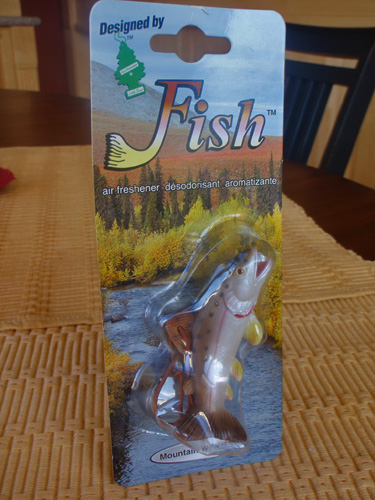
Air Fresh Trout

Disclaimer: This is a Gear Review. After promising a blog free of gear reviews, I find myself posting my second in less than a month. But if writing is an art and art imitates life, and life is full of empty promises then why should not my writing be so inclined?  One of the great things about fishing is that it so often yields unexpected and delightful surprises. It’s common knowledge to those of the angling ilk that life imitates fishing, and so it was that I stumbled upon this little gem quite incidentally when I stopped by the local Duvall Auto Parts store to pick up a replacement headlamp bulb for my Jeep. Having never before seen this item at a fly shop or in one of the many fly fishing catalogs that arrive in my mailbox throughout the year, one can imagine my surprise and delight to discover it at an automotive store of all places. With the Holiday Retail Season officially underway, I thought some of you might searching for that perfect stocking stuffer either for yourself or the discerning angler in your lives.

I’m a wee bit of a gear whore, and profess to having a weakness for fishing gadgets. But I also like a good deal. The invoice lists the item as “air fresh trout”, and for $4.63 I figured couldn’t go wrong. Brought to you buy the same manufacturer of the world-renowned line of “Little Tree” air fresheners, this one is simply called “Fish™”. That’s right – Fish air p92607441fresheners: An oxymoron if there ever was one.  As much as I love catching, releasing and sometimes catching and eating fish, the smell is unmistakably…fishy. It doesn’t take an experienced angler to realize that fish are not known for having the most pleasant of odors in the world. In fact, the smell of fish is unpleasant enough to be used when describing house guests that linger past their welcome. Remind yourself of this fact as the relatives from out of town arrive at your house for Christmas this year.

Fish air fresheners, indeed! My first thought was that that the marketing guru behind this product had probably lost his or her job due to this glaring little oversight, but closer inspection of the packaging revealed that “Fish” is apparently not the actual scent, but rather the name given to this particular product line. The actual scent is listed as “Mountain Waterfall”, p9260748which conjures up visions of, well, waterfalls in the mountains. Now I always thought that water, which includes waterfalls, doesn’t really have a scent unless brackish or somehow horribly contaminated, neither of which would seem likely given that this a waterfall in mountains. Apparently I was mistaken because this mountain waterfall does have a detectable scent. To describe the aroma, close your eyes and imagine yourself in a beautiful alpine meadow: In the distance a bubbling brook cascades down the side of a mountain, the mist from which combines with the naturally sweet scent of wildflowers and wafts gently toward you on a light breeze.  It’s nothing like that.

All kidding aside, I have smelled many air fresheners that are much worse than this. One has to admit that seldom does the air freshener smell worse than the odor that one is attempting to mask, but some air “fresheners” are a bit overbearing. Some are downright nauseating. My daughter has one such device hanging from the rear view mirror of her car that is supposed to resemble “Piña Colada”. It’s a sickeningly sweet smell that reminds me of, well, a piña colada. By comparison the little plastic trout from the waterfall in the mountains is really not unpleasant at all, nor is it so overpowering that you will need to drive around with the car window down for the first 2 weeks of ownership before it can be tolerated.

To save you all the trouble, I did a little research and it appears that this particular piece of fishing gear can be found online by using the keywords, “trout air freshener“. However, the search results are misleading as it is mistakenly listed as a “rainbow trout air freshener”, when clearly it is a brown trout air freshener. This sort of technical oversight might go unnoticed by the general public, but discriminating anglers on the quest for a rainbow trout air freshener would surely take note of the inaccuracy.

After three weeks of field testing, I have some solid data to report: The air freshener is not quite up to the task of competing with the combined odors of wet dog, soggy waders and second hand Mexican food that linger in my Jeep. It was determined that a second Air Fresh Trout would be needed to effectively wage battle, but when I went back to the auto parts store to pick up another one they were out of stock (apparently this is a hot item). I considered ordering one online where the price is cheaper, but shipping charges would negate any cost savings, and besides I like to support the local shop when I can. The clerk promised to call me when more inventory arrives, and when it does I’ll let you know if my car takes on the smell of a mountain waterfall, or continues to smell like a brown trout.

In conclusion, I highly recommend you have a few of these on hand for the Holidays, to give as gifts or to hang in your spare bedroom. Remember: Fishing has established limits – so should the duration of visits from out of town house guests: 2 days, tops.

pa070773

Year of the skunk. Almost.

The ink from last week’s blog entry was barely dry when I received a text message from Marck. Expecting criticism for having taken certain creative liberties in my post, I was surprised to see the words pop up on the screen of my phone: “Yak tomorrow?” Unlike me, Marck is a man of few words. Texting is a rather unpleasant endeavor for me because I have a hard time buying into the whole “textspeak” thing, with its baffling array of acronyms and abbreviations and lack of correct punctuation and proper grammar. It would have taken me 25 minutes to respond with the following text message: “Good day, Marck. I received your digital communication regarding the matter of fishing the Yakima and yes, that sounds like a rather grand idea and one that I would greatly enjoy partaking of. If you’ll allow me the courtesy to first check with Mrs. Unaccomplished Angler before I commit to joining you, I will get back to you just as soon as possible. Thank you for the invitation. I look forward to conversing with you in the very near future and hope all is well. Very sincerely, The one who is rather unaccomplished in the ways of fly fishing.” So rather than reply in kind I opted to actually call him.

Then I sent an email to Mrs. Unaccomplished Angler announcing that I was going to go fishing with Marck. The reply was not encouraging: “You have a chore list to do.” Oh, yeah, that: The honey-do list that was taped to my computer so I couldn’t ignore it. pb220431“Yeah, yeah – I’ll get to that when I can. By the way, what’s for dinner, woman?” should have been my response. With no further discussion, I called Marck once again and told him I wouldn’t be able to go. I stared at the list for a few minutes and it became painfully clear what my Saturday was going to consist of: Change lightbulbs, sweep driveway, take cardboard boxes to recycling bin, sweep out garage, clean fireplace glass, and my favorite: Clean your office. When she got home from work a short while later I was moping around the house like a dog that had been punished for taking a crap on the living room carpet that had just been shampooed. I was caught completely off guard when she asked what time I was leaving in the morning to go fishing. “Huh?!” As it turns out, I could go fishing as long as I was aware that my list had to be completed by the end of the weekend. My spirits were instantly lifted and I quickly fired off the following text message to Marck: “stillgotr oom in the hornet 2morrow i cango : ) LOL”

Per standard operating procedure I arrived at Marck’s house, refilled my coffee cup, and we headed east on I-90 with the Hornet in tow. It was just the two of us on this day – apparently Sir Lancelot (not his real name) wasn’t man enough to inform his wife that he would be going fishing and anything else could wait for another day. Several feet of snow had fallen in the hills recently, providing a good start to the winter ski season, but fortunately the road conditions over Snoqualmie Pass were bare and wet. We made good time, and it was 9 AM as we drove the Canyon Road to Red’s Fly Shop to arrange for a shuttle. Along the way we saw one lone soul wading a river that was otherwise strangely devoid of anglers. As we pulled into Red’s, which is usually teeming with optimistic fishing folks, the gravel parking area was empty. Surprisingly the boat salesman had apparently taken the day off, and only Leif was working the counter as we pb210433walked into the shop. From the reception we received one would have thought we were his long-lost best friends, who’d come to party and hand out cash prizes. He was obviously deprived of human interaction, which probably meant nobody had been in the shop for days, which meant the fishing had probably been slow, which meant staying home and chipping away at a honey do list might not have been such a bad idea. But here we were, so we arranged for the shuttle, plunked down a couple bucks for some token flies (purchased out of sympathy, as we didn’t really need any), and made our way back up the canyon to our launch point.  We were going to float 4-1/2 river miles and planned to be off the water by 3:30 so Marck could be home by 5 PM for a party.

There was one drift boat with three passengers at the put-in when we arrived. Weather report: 34 degrees under sunny skies and no wind. We layered up accordingly and dropped the Hornet into the low, 41 degree waters of the Yakima river. After having been humbled the last dozen or so times on this river, I had declared today to be a day of redemption. A bold declaration for sure, everything looked just right for a great day on the water, and it should be noted that Marck had wisely opted for his old standby Red’s fishing hat. We strung up our 6 weight rods with indicators and double fly rigs: I opted for a brown Pat’s Stone with a #20 Lightning Bug dropper; Marck tied on an olive Sculpzilla followed by a Copper John. Immediately after launching we rowed across the river a short ways and anchored up on a gravel bar. A particular side channel looked fishy and we wanted to cover every piece of promising water on this day, which would very likely be our last jaunt to the Yak before spring: It was the third weekend in November, and winter could take hold at any moment. And so on this fishy-looking side channel I made my first cast, tossed a mend into the line and watched. The strike indicator dipped, but I dismissed it as the swirling current simply up to its cruel tricks of deception. However, when I lifted the tip of my rod it became readily apparent that more than the current was to blame for submerging my bobber. I was a bit too hesitant in my attempt to set the hook, and saw the fat rainbow roll below the surface and spit my fly. Good looking fish- probably 15-16 inches. Just as well – it’s not like me to have good fortune right off the bat, or at any other time for that matter. We boarded the Hornet once again and proceeded downstream.

pb210442This wasn’t the usual stretch of river we typically fish, so the change of scenery was sure to make a slow day of fishing more interesting. Navigating this section of the river was a bit more challenging as well, so whoever was on the oars at any given time had several opportunities to yell, “Hold on!” as the other braced themselves for a bumpy ride or ducked to avoid low-hanging overhead branches. However nothing really out of the ordinary took place for the first hour or so, and it didn’t appear as though the day was going to give up much fodder worth reporting. I did manage to land a couple Whitefish, but nobody with any self-respect boasts about catching these much-maligned fish.

Whitey: The Disrespected Fish.

Whitey: The Fish of Great Disrespect

This is something I’ve never quite understood because afterall, they’re a native species and they swim where trout swim so if a whitey puts a bend in your rod, so be it. The way I figure, it simply means you got your fly where the fish are – so what if the fish you caught wasn’t what you intended, right? I mean, heck – one occasionally hears of anglers catching a steelhead when engaged in the act of fishing for trout, and that’s an example of an unintentional by-catch, isn’t it?  Wait, never mind. At any rate, my second whitey was actually a fairly large specimen and I even hooked it in the mouth, of all places.

Marck was still fishless at this point, but neither of us worried about that. There was still plenty of day left and he’s a fishy dude so it was just a matter of time before he caught on. In the meantime, I managed to hook into my second biggest trout ever on the Yak: A beautiful 18-inch rainbow that fell victim to my Lightning Bug, and gave me several pb210436minutes of sporting entertainment before finally cooperating and coming to the net. It was 2-1/2 years earlier when I caught a similar sized fish on this river, and the time between had come to be known as “The Lean Years”, with few fish being caught overall, and none of those fish being more than 12-14 inches. I’d also tasted a skunk more than a couple times during this era of famine, so catching this solid fish began the healing process.The sweet smell of redemption still lingered in the air when I landed my next fish: A feisty 14-incher that I plucked from behind a log in water that looked so good there might as well have been a sign posted that read, “There’s a fish here – Guaranteed.” Landing this second trout brought me much additional pleasure, and grinning a smug grin I happily took the oars so Marck could angle. I’m not one to be greedy or spiteful, and I really did not want Marck to go fishless on this day.

We covered a lot of great looking water in our quest for Marck’s first fish of the day. While neither of us had mentioned it, we were both keenly aware of the fact that his catch record was in dire jeopardy, and as we entered the last hour of the day there rode with us an elephant in the rear seat of the boat. pb210447At one point we anchored the Hornet on an island to work some nice looking water, and Marck walked off a ways so he could be alone with his worries. It was clear that he was troubled. As Marck grew more serious I knew better than to tease him about something like this. I rowed in silence and began to ponder the headline of my next blog entry: “Marck Tastes a Skunk!”, or “Hey Marck – How Do Ya Like Them Apples?” It would to be a tough decision, but thankfully one I would never have to make because shortly thereafter he set the hook on an adorable little 9 inch rainbow and secured his skunk-free record. After releasing the fish, Marck requested another turn on the oars to warm up his hands. By now the sun was fully behind the clouds and a wind was starting to bite at us, so I humored him: The reality was that he was emotionally spent from the ordeal, and he needed some quiet time to reflect on having escaped shame and public ridicule by the narrowest of margins. This was a man who came dangerously close to epic failure…all color had drained from his face and a cold sweat beaded upon his forehead. He regained his composure and warmed his hands on the sticks.

Checking his watch he announced that it was 4:15. “Uh…Don’t you have to be home by 5?” I asked rhetorically. Marck decided that he’d just call his wife and tell her we were on our way, and that we were about an hour away from arriving home. I tried to discourage him from lying to her, but he assured me it would be okay. And truth be told it wasn’t really an all out fib because from the time we launched we were ultimately on our way home. As Marck dialed his wife’s number, he reminded me fishermen are notorious liars. He had a point. In reality we were probably 15 minutes from our take-out and another hour and a half from home, assuming it wasn’t snowing on the pass. As Marck spoke to his wife and explained that the roads were icy and the going was slow, my indicator took a nose dive and I’m pretty sure Mrs. Marck didn’t hear me yell, “Fish on!”. Enticing the 10 inch rainbow on the Pat’s Stone topped off a much better than average day, and it was good way to end the year. Let the icy grips of winter have the Yak – I’d had my day of redemption and was heading home with the smell of fish on my hands. Now, if I could have just gotten Marck home in 20 minutes he wouldn’t have had to spend the night in the doghouse.

pb210443pb210445

Note: If after reading the accounts of this day you feel that the Unaccomplished Angler is becoming an accomplished braggart, fear not – winter steelhead season lies just ahead. I am bracing myself to have my posterior handed to me accordingly.

« Older posts Newer posts »