Category: Random Reviews (Page 3 of 3)

Occasionally I will offer my opinion on gear and assorted fly fishing doo-dads.

No Shortage of Good Reviews

BREAKING NEWS– John Gierach’s latest book, No Shortage of Good Days, is available! At the time of this writing I received my copy, special ordered from Bobwhite Studios, about three week’s ago. It’s a signed edition, autographed by Gierach himself and personalized by cover artist Bob White, which makes me feel pretty cool (although I’m not).

I’m no literary critic. As a very well unknown author myself, I fear respect those who would write reviews – at least honest reviews. Unfavorable ones are the worst, or perhaps the best, because they’re honest. And there should be no other type of review, because if the review isn’t honest then it has no merit. Reviews are, however, simply opinions of the individual and should be taken with a grain of salt. And maybe a splash of tequila for good measure in case it’s of the unfavorable variety.

If you want a good review of No Shortage of Good Days, I suggest you look elsewhere. By that I don’t mean go looking for a favorable review elsewhere, just a review written by someone who writes good. Here are a few blog reviews worth your time to visit:

The Trout Underground. Make sure you’re not in a hurry, and have a full mug of piping hot coffee at hand before you commit to Tom Chandler’s epic novel review. It’s comprehensive. Well-written. It’s long. I think when Tom wrote this he was in dire need of a fishing vacation. The suspense builds over the course 3 days as Chandler teases us – offering brief glimpses into what is to follow – 5 times before actually delivering the full meal deal. Good God man! Honestly, given the attention given to the book, it’s as if Chandler worships the paper Gierach writes on, in much the way that we hack bloggers idolize The Trout Underground. He’s clever. His review is worth the commitment required.

Up The Poudre. I don’t want to publicize the name of the blogger responsible for this review for fear of blowing his cover. You see, he has wisely exiled himself to the remote hills in Colorado. If you know where the Unabomber hid out, you know where I’m talking about. He (not the Unabomber) is in hiding: posting blog updates via a satellite up-link. Eventually Google Earth’s cameras will find him, if Gierach’s henchmen don’t first. Godspeed, Sanders man. It’s an honest review, if even for having only covered 2 chapters. It brings up some interesting things to ponder about blogs perhaps taking the place of books for some people.

Casting Around. I’ll admit that when I stumbled upon this review, it was the first I’d heard of this blog. I’ve no doubt there are countless other good blogs out there that I’ve never seen nor ever will. There are just so very many blogs, and so very little time. Blog keeper Anthony Naples scribes a good review here, and by that I don’t mean it’s favorable (though it is), but is well thought out and well written.

If I were to take a stab at reviewing No Shortage of Good Days I would have to say that there’s very little that I can find to be disappointed with, and quite a great deal that I enjoyed. However, I do have a couple issues that have nothing to do with whether or not Gierach’s latest book is being redundant and giving us more of the “same old same old” as he continues to weave insight into his entertaining angle on fly fishing…No, what I have a beef with are a couple of glaring inaccuracies. First, in Chapter 2, page 14, Gierach writes:

Vince and I rented a car at the Seattle airport, drove north along the coast, and got a room at a motel in a small town not far from the river. This was a typically characterless American burg beside an interstate comprised of cookie-cutter housing developments, strip malls and burger joints: everything quick, cheap, and temporary in the interest of hyperconsumerism.

He had me until “drove north along the coast.” Allow me to veer a bit off course for a moment as I explain.

People in “Eastern Washington” which is anywhere east of the Cascade Crest according to many wet-siders, are prone to referring to those of us in the greater Seattle/Puget Sound area as being from “the coast”. People from Spokane are particularly fond of this inaccurate term of endearment. Well, I’m here to tell you that while the salt water in Puget Sound may well be the same salt water that can be found in the Pacific Ocean (connected by the Strait of Juan de Fuca), Puget Sound is not the coast. In fact I fished within 10 miles of the coast this past Spring, on the Hoh River out near Forks. It was a 4 hour trip from where I live, which is near Seattle (you know, on “the coast”).

But back to Gierach’s book. In Chapter 2, aptly titled “SKAGIT”, Gierach is bound for the river by the same name to chase the elusive wild steelhead with Dave McCoy of Emerald Water Anglers and Dylan Rose of Skate the Fly. The Skagit River empties into Puget Sound not too far the town of Mount Vernon, Washington, which should not to be confused with George Washington’s Mount Vernon in Virgina (by the way, there is a street by the name of Virginia in the town of Mount Vernon, Washington). The Skagit is not a coastal river. The body of water that Gierach would have glimpsed as he drove north along I-5 was Puget Sound, not the Pacific Ocean. In his defense, it’s a confusing region because Vancouver is located  164 miles to the south and also 141 miles to the north of Seattle (click on map for clarification).

One other inaccuracy that I had a hard time letting go of occurs on page 56 of Chapter 6: BAJA. Gierach talks of the hazards of standing barefoot in the surf while casting to roosterfish.

“…and the water can be filled with chunks of dead jellyfish that have been churned into pieces by the waves. They sting your feet and bare legs painfully, but they’re harmless unless you get a big piece. You learn not to complain because the only known remedy is urine—your own or someone else’s.”

False! I questioned this jellyfish-sting remedy years ago after watching a television sitcom (I think it was “Friends”) where one character was stung by jellyfish and another character peed on them. This organic first aid treatment is nothing but an old wive’s tale, according to an ABC News Health article. Perpetuating such a myth is irresponsible journalism because it may result in scores of people needlessly urinating on each other at the beach. It does, however, make for more entertaining prose than if Gierach were to have said, “It’s a sound idea to always carry with you a bottle of vinegar to treat a jellyfish sting.”

Having said all that, no doubt Gierach’s covert band of revenging henchmen will soon be seeking me out to issue forth a bit of discipline, thus, I’ll be entering the Witness Protection Program. I hope that they put me somewhere near the coast. Forks would be nice. There’s good steelhead fishing out there, and not many stinging jellyfish to be worried about. Maybe if Gierach had gone to Forks in chapter 2, he might’ve caught a fish.

As for the rest of the book? I liked it. I’ve read a few of his other books and liked them as well. Gierach’s writing style suggests that he’s a regular dude—a regular dude who just so happens to be a legend in the eyes of fly fishing readers worldwide. He doesn’t try to impress or intimidate by casually throwing around big words (I only had to look up one word in chapter 6: abrade). The format of his books works well for me as they are a compilation of short stories broken into chapters. The older I get the more my attention span seems to shrink (along with loss of muscle mass), so novels and such, which require great commitments of time and feats of strength, are something I find myself reading less and less often. With Gierach’s writing I can easily knock out a chapter during a brief respite in my day (I was going to suggest that these quick pit stops usually follow my first cup of morning coffee, but that was already alluded to on page 76 of chapter 8: BOOK TOUR).

Will you like No Shortage of Good Days by John Gierach? Maybe. Maybe not. Certainly what I’ve said here will not impact your opinion in the way that a good review might.

"Close to Home" by Bob White


By the way, the cover illustration for No Shortage of Good Days is worth the price alone, which happens to be $24. The illustration by Bob White is titled, “Close to Home” and was originally created to illustrate Gierach’s 100th column in Fly Rod & Reel magazine. It is available in 3 print sizes, signed by both the subject and the artist, via Bobwhitestudios.com.

Review: Sage DXL Typhoon Chest Pack

When I started this blog I never intended to review anything, as stated on my WELCOME page. And I’ve stayed mostly true to my words, although occasionally in moments of weakness I’ve deviated. Well, that ends today with my official review of the Sage DXL Typhoon Chest Pack.

Sage DXL Typhoon Chest Pack

For you naysayers who might proclaim that the Unaccomplished Angler has no grounds for reviewing anything, I would agree for the most part. However I submit to you that I am perfectly qualified to review the Sage DXL Typhoon Chest Pack if only for one reason alone: I live in the Pacific NW where water falls from the sky 10 months of the year.

This chest pack by Bainbridge Island-based Sage Manufacturing hails from the family of DXL Typhoon Bags that include the large and small waist packs, backpack and boat bag. The common elements of the Typhoon series is that they all feature hybrid zippered/magnetic closures and welded construction for exceptional waterproof qualities. And they’re pretty cool looking. DXL is an acronym for “Destination X Luggage”, suggestive of the fact that no matter where your fishing destination takes you, this is the luggage for the trip. And if your destination takes you into a Typhoon, don’t despair: this stuff can take it. For you techno material geeks, the gray rubberized stuff is TPU coated Nylon.  The green material is PU coated HT (high tenacity) Nylon. Tough stuff that appears to be very durable.

This is the first chest pack I’ve ever owned, and it’s ironic that just recently I said I didn’t have a chest pack. Luckily I also said that I would never say never to owning a chest pack. Upon receiving the DXL Typhoon Chest Pack in the mail, I quickly headed out into the cold, damp late November weather to put it to the test on the banks of a local river. It was wet and cold. Winter steelhead season. Did I mention it was wet? I performed as I had hoped, keeping everything inside nice and dry.  I also mentioned it was cold, so I came back inside to write my review and shoot some product photos.

First off, I like the size.  It’s not terribly large, and that’s a good thing.  When I want to carry several boxes of flies and all my fishing doo-dads, I use my Sage DXL Typhoon Large Waist Pack and usually I’m fishing for trout.  Steelheading is a much more minimalist endeavor, requiring a fraction of the gear I carry with me when chasing their resident cousins.  A box of nymphs and beads streamers, a pair of forceps, a spool of 12lb tippet material, a couple of protein bars and a flask (for medicinal purposes) fit neatly into the Typhoon chest pack, with room for a few more items.

Like my Typhoon waist pack, the chest pack has built-in sheaths on either side for stowing forceps, a magnetic storm flap closure and magnetic points for keeping tools from flapping around. On top of the pack is a velcro strip fly patch to keep nymphs and beads streamers at the ready.  I realize it’s not needed, but I like to attach a foam patch here (not included). While the pack is designed to be worn as a true chest pack, it’s very versatile and I prefer to wear it as a sling, keeping the bag at my left hip and out of the way when executing two-handed Spey casts. The waist strap, which holds the pack securely in front when worn as a chest pack, is easily detachable for wearing it as a sling.

A feature common on any good chest pack is the fold down tray so that you have a mini workspace right in front of you.  On the Typhoon chest pack this platform is completely adjustable, allowing you to open the tray as much or as little as you prefer. The velcro tray securely holds flies while you’re selecting the right pattern for the job, or perhaps tying up a double nymph rig (although there would be no reason for this when fishing for steelhead because any respectable angler only swings flies).

Inside the pack are a couple of fairly large pockets for holding a few doo-dads and keeping things organized. You’ll note a tube of sunscreen in the photo which is just for staging appeal–clearly there is no need for sunscreen while winter steelheading.

The Sage DXL Typhoon Chest Pack gets two thumbs up from me. It’s not large enough to carry everything, but it fills a niche nicely. Unfortunately it doesn’t make me a better caster, nor has it landed me a steelhead, but it does a great job of carrying a few necessities. If you’re looking for a waterproof, rugged, versatile pack and don’t need a lot of carrying capacity, look no further than the Sage Typhoon Chest Pack.

And with the Holidays upon us,  if you’re looking to give a gift that will put a smile on any angler’s face, this is it.

Are you man enough for a Fanny Pack?

Chuck Norris sporting a fanny pack.

One of the most common questions I come across in fly fishing discussions, besides whether to nymph with beads or swing for steelhead, is the matter of personal luggage used to carry all of one’s doo-dads when out fishing.  There are many choices, from the traditional fly vest to all manner of packs worn either on the back, the chest, slung diagonally over one shoulder, or around the waist.  It’s all a very personal matter of opinion, and yes – I’m going to give you my thoughts on my experiences with doo-dad carrying devices.

For reference, “doo-dads” may include such things as tippet spools, nippers, hemostats, fly boxes, leader wallet, floatant, dessicant, sink putty, Thingamabobbers, hook sharpening file, Monomaster, stream thermometer, camera, bug spray, sunscreen, handwarmers, TP, first aid kit, flashlight, Leatherman tool, wallet, fishing license, etc. Your list may vary, but I tend to carry a lot of crap necessary items.

CHEST PACKS

Never had one so I can’t offer much there, other than that fact that I’m reminded of Dr. Evil and Mini-Me. I can see the advantages of having things right there in front of you at all times, so trying such a doo-dad carrying device is not out of the relm of possibilities. In other words, I’ll never say that I’ll never have a chest pack.

BACKPACKS

This gives me cause to harken back upon my days in the Boy Scouts, when ill-fitting and improperly-loaded backpacks were filled well past the Gross Combined Weight Bearing Capacity of both the youngsters and the packs. Given my tendency to carry as much as a device is capable of holding, it’s best that I don’t use a fly fishing backpack. I’m sure they work well for some folks, but it seems to me that if things are kept in a pack on your back, said things would be not readily accessed. However if you are hiking to a destination where you’ll need a ton of stuff I can certainly see the benefits to a backpack, especially one designed to carry rods and other fly fishing specific gear. If you use a backpack just be sure to check daily to make sure some hooligan didn’t hide a 5-pound rock in the bottom. If they did you want to find it immediately and not carry the rock around for several days before discovering it.

VESTS

Ah, the old traditional fly vest (and some vests are anything but traditional). I had one for many years, and it held a lot of stuff.  And that was the problem: it held so much that I felt compelled to take everything with me (see list of doo-dads above). I had a good system for stowing all manner of things in their own pockets, so I knew exactly where everything was when I needed it.  The problem was that after a day of fishing I felt the strain of having carried what felt like the weight of the world on my shoulders.  Also, during the hot summer months I didn’t like having all that material wrapped around my upper body (although according to the photo above one needn’t necessarily wear anything under the vest). Still, there was something I liked about the carrying capacity of a vest, and I moved away from it begrudgingly.

Sage DXL Lumbar Fanny Pack

F#NNY PACKS

*Gasp* Just the sound of it causes uncomfortable shivers up and down my spine – so much so that I cannot even say the word. Butt after I did away with my vest I went with the Sage DXL Lumbar Fanny Pack. I liked it because when cinched snug around the waist it was like wearing a lower back support belt. The DXL Lumbar Fanny Pack has many nice features, though it is lacking a fly patch (easily remedied by adhering a velcro strip to the black plastic surface below the Sage logo). The pack is moderately sized and therefore limited what I could take with me. Lightening my load was undeniably a good thing, although I occasionally pined for a few of the items that I was forced to omit from the pack. The only thing I didn’t like about the DXL Lumbar F#nny Pack was that it was not very resistant to water. When exposed to wet conditions the pack tends to get damp, inside and out. When it happened to sit in the bottom of a drift boat on a rainy day, it would become waterlogged. And while I rarely wade deep enough for pack worn around the waist to get wet, that was also an issue on occasion. One day while fishing the Yakima River with Marck, a young lady who was part of a Rubber Hatch flotilla yelled to me, “Nice f#nny pack!” Usually I’m a fairly confident conversationalist, but this time I was left speechless in the face of the sarcastic comment. I became withdrawn because she was right: it is a f#nny pack. One would think that by the time a person gets to be my age, their self confidence would serve as a barrier to any negative outside forces. I never fully recovered from that sarcastic barb, so I kept looking for an improved option for carrying my stuff.

2009 saw a new offering to the marketplace that caught my attention:  The Sage DXL Typhoon Waist Pack. Now there’s something I could live with – a waist pack (take THAT, Miss Smarty Pants!). I read a review of the pack over at Deneki Outdoors and was intrigued. I was also initially put off by the price tag of $200 for the large model, which is the one that I was interested in. I thought perhaps if I waited long enough the good folks at Sage would send me one as a “thank you” for publicly proclaiming to be a Sage Whore Poster Boy, but that offer never materialized.  Some months later, in a moment of weakness while visiting my local fly shop (All About the Fly in Monroe, WA) I broke down under owner Ron Torda’s hard-sell pressure and bought one. The large size (the one with the large price tag).

Sage DXL Typhoon Large Waist Pack

The DXL Typhoon Large Waist Pack is in fact large (671 cubic inches), which in my assessment just means there’s more to love. And after doing some math I realized that the pack only costs 30 cents per cubic inch, so the price isn’t really as bad as I originally thought. The Typhoon Waist Pack is a waterproof/heavily water resistant combination of rubber-coated nylon and a heavy duty ripstop nylon material with one compartment that is completely submersible thanks to a dry suit-style zipper. Overall the waist pack is big enough that I can carry everything I want, including the kitchen sink. In fact this thing carries more than I ever dreamed of carrying in my old fly vest, but now the weight of the world is on my hips, where it should be.

The waterproof zipper compartment is roomy enough for carrying things that need to stay dry should one submerge oneself involuntarily while wearing the pack. This waterproof compartment is suitable for things such as a wallet, camera and perhaps blasting powder. The main storage compartment is a vast, cavernous place that’s capable of holding a few fly boxes, a case for sunglasses, a flask and even a shirt or article of clothing rolled up. There’s also room for lunch (I recommend placing the sandwich on top). Six inner divider pockets are slick for organizing all manner of small doo-dads. There is also a large velcro fly patch on the inside of the compartment. I opted instead to attach a smaller foam fly patch (not included) to the outside (just my personal preference). Waterproof (but not submersible) zippers secure the main compartment, which is then covered again by a storm flap that stays closed using a couple of magnets. Sometimes when I’ve overstuffed the pack the storm flap doesn’t want to stay covered due to the magnets not quite lining up.  That’s easily remedied by reducing the amount of stuff I take with me. Again, this is not a bad thing.

The exterior of the pack has several points where zingers and a tippet spool can be attached (get creative). As noted there is a velcro strip for a fly patch, a couple of quickly-accessed pockets for oft-needed items such as floatant, and a couple of ingenious sheaths for holding hemostats/pliers. There are also a couple of magnetic spots to keep things like nippers from flopping around. Cargo straps on the bottom of the pack will hold a rain jacket when rolled up (I’ve enjoyed this feature several times), and a small, zippered mesh pocket on the waist belt is handy for keeping things that you may need quickly and often. I keep my waterproof point-and-shoot camera there so that I can quickly extract it for shooting photos of Marck’s nice fishes.

Even when loaded up with all that its capable of carrying, the Typhoon pack is very comfortable. The waist strap is extremely well padded and when cinched tight gives that lower back support which can be nice after wading a freestone river all day if you happen to have middle-aged back. There is also a removable, padded shoulder/neck strap: I like to wear it like a sling: over one shoulder so the pack sits on my hip. That makes it easier to get at stuff and it also serves as a nice arm rest. When worn this way it does not interfere with either arm when casting.

Another comforting thing is the fact that this is not a “f#nny” pack: it is a pack that is worn around the waist. This has allowed me to enjoy my DXL Typhoon Waist Pack to the fullest – guilt free of any awkward association having to do with the buttocks region. The pack is quite masculine and rugged, so it suits me to a T.

Oh, and it also has two nifty beverage holsters so I can carry a couple bottles of Zima with me.

Fully submersible compartment for things that must stay dry at all times.

Cavernous main compartment

Outside pockets for easy access.

Plenty of padding for maximum comfort.

Sheath for hemostats (retainer strap not included- my idea)

Walk tall and carry a short stick.

Rod Review: Pygmy Glass by Scandalous Sticks

Upon inception of the Unaccomplished Angler I proclaimed many things that the blog would NOT be, and one of those promises was that there would be no gear reviews: I’d leave that to the big kids. I’ve largely held true to that promise, though I have broken down a couple of times. Wrought with guilt, I apologized for my errant ways. Well, I’m officially not apologizing this time because raving about this product is nothing to feel shameful about.

Scandalous Sticks is a custom rod company with a killer logo, if I do say so myself. Owner Stephen Vance builds a wide variety of custom rods, all of them unique (as one would expect from a custom built rod). One rod, however, stands above the rest in that regard: The Pygmy Glass 5’6″ 4 weight. It’s stated that the Pygmy “has more personality than some people” so I was eager to spend a little time in the back yard getting to know this little rod. My back yard has an expanse of grass but it does not have a river running through it so I was only able to lawn cast the Pygmy. Unfortunately this rod is not mine to keep (I’m donating it to an auction for Casting 4 A Cure) so I didn’t want to take it out to a body of water and risk catching a fish with it. When the rod arrived I was a little short on time needed to spend with it. However I couldn’t resist temptation so I strung up the Pygmy for 5 minutes of wiggling and fondling. I was officially intrigued, and the next day I gave the Pygmy my undivided attention.

I’ll be honest, I don’t really know much about fiberglass rods, other than the fact that my first fly rod was glass. My memory of that rod supports my (perhaps partially false) perception that fiberglass rods are noodle-like devices that require a very slow, reptilian casting stroke. Well, the Pygmy is not your father’s glass rod. Now before I continue I want to address what I know you’re thinking: “Holy tuna can – that’s a short rod!” I thought the same thing the first time I heard about the Pygmy, and I doubted whether or not such a short rod could store enough energy to be worthy of laying out a respectable supply of line. After all, doesn’t a real fly rod need to be much longer? Well, apparently size doesn’t matter – at least with regard to the Pygmy. The long and short of it is that little five and a half foot rod is more than up to the task of casting plenty of line.

To be perfectly accurate, the rod I tested is 5’7″ due to a fighting butt that adds an inch. That fighting butt may be more than just eye candy as fish in the range of 30 inches have been landed on the Pygmy, according to the Scandalous Sticks website. A fish that size is going to require a reel with a decent drag – you probably don’t want to palm a hog brown that’s hell-bent on making short work of the person on the other end of the line. For casting practice I tested the Pygmy using two different reels: My own Ross Evolution 1.5 and a Redington Drift 3/4 (also donated for the auction by the good folks at Redington).  The Ross is a perfect match for my 9 foot 4 weight rods but felt a little big for the Pygmy. At 3.7 ounces the Redington was a nice fit.  The balance point was about 3 inches behind the leading edge of the cork grip, so perhaps a bit further back than what textbook guidelines suggest. However, with such a short rod a reel would need to be nearly weightless in order to balance where a typical longer rod does.  This didn’t bother me one bit: the entire outfit is so light in the hands that the matter of a balance point was the furthest thing from my mind. As for aesthetics, the titanium Redington looks real sweet when attached to the nickel silver up-locking reel seat.

As for casting this little rod, I was surprised at how easily it laid out 35-40 feet of line (an accomplished caster could have done so farther). It should be noted that all of my fly rods are late generation graphite rods: fast action stuff. To that end I was leery that the Pygmy would be ill-suited to my casting stroke. I was more than pleasantly surprised at how quickly the rod loads and recovers and I can honestly say that I didn’t have to alter my casting stroke much at all to throw tight loops accurately. To put a label on it, because fly anglers like to do so, I would suggest that the Pygmy is on the faster side of medium.  Perhaps even medium-fast. Whatever the case, being on the short end of the stick was a good place to be. Being fiberglass, the rod does flex and the tip feels sensitive. I can see that presenting a dry fly with finesse would be easy and playing large fish would certainly be a thrill with this little beauty. But one must remember that while the rod is unusually small and may feel delicate, it IS a 4 wt rod and up to tasks greater than the size of the rod might suggest. As Mr. Vance says, the Pygmy is a glass rod with a graphite background.
The 2-piece blank of mysterious origins is a honey mustard yellow, with brown and black thread wraps holding stainless steel chrome guides firmly in place. The wood used for the reel seat is blonde Israeli olive wood and the grip is high grade Portuguese cork.  The whole package is very classy to look at; the construction flawless. Each Pygmy is signed by Steve Vance and assigned a production number: this particular rod is numbered 0021.

Advantages of the Pygmy over a longer rod are many, given that it can still stand toe to toe with longer sticks in practical fishing situations:

  • Stringing up the rod is a snap because even someone as vertically-challenged as myself can thread the line through the tip guide without having to stand on a milk crate or lay the rod horizontal.
  • The Pygmy is very manageable when walking through doorways (or down a brush-lined trail).
  • When the wind blows, and it nearly always does when fly fishing, the short rod would be much less negatively affected than “normal” length rods.
  • The Pygmy wouldn’t take up much room in a boat or float tube.

The above-mentioned points suggest that this might be a perfect rod for kids for the very fact that it’s so totally not cumbersome. When you propose the purchase to your CFO, remember to tell them that this is for your child: that seems to gain purchase approval much more easily than if one making a selfish acquisition. The CFO need not know that once you get the Pygmy in your hands the last thing you’ll want to do is give it to your kid!

Since there are only 5 more Pygmy blanks available, one would be prudent to contact Scandalous Sticks and place their order today (they sell for $400). There may be only 4 left after I ask Mrs. UA if I can have one for myself.

Stay tuned for more information about the Casting 4 A Cure auction that will feature this Pygmy, the Redington Drift reel and Rio Mainstream WF-4F flyline, and a host of other great stuff!  See the Auction HERE

I wouldn’t know a good cast if it hit me on the back of the head, but I do like Dry Fly whiskey.

It seems as though the Federal Government has always felt a need to protect the American people from themselves. Be that good or bad, it is what it is and one of the broadest examples of this in the history of our nation was Prohibition.

On December 22, 1917 Congress submitted the 18th Amendment to the Constitution which prohibited ‘the manufacture, sale, or transportation of intoxicating liquors.’ And so at midnight on January 16, 1920 began the Prohibition Era, which would last thirteen years. It seems a cruel irony that when America was in the midst of The Great Depression (1929-1939) and folks needed a stiff drink they couldn’t get one legally. Now I’m not condoning excessive drinking, but when the chips are down a person ought to be able to drown their sorrows if they so choose. Thankfully the 21st Amendment to the Constitution put an end to Prohibition in 1933.

The effects of Prohibition, however, lingered for a very long time and in fact still exist today. Many states created rules requiring the separation of the production, distribution and retail tiers to limit the potential for anti-competitive practices and to discourage the over-consumption of alcohol. Washington (the state) at least for the time being, controls the sale of liquor. That may be ending in November depending on the outcome of a statewide vote. In the 80 or so years that followed the end of Prohibition, not a single (legal) distillery operated in Washington. Then a law was passed that made it a little easier for alcohol makers to craft their wares, and in 2007 Spokane’s Dry Fly Distilling became the first licensed distillery to operate in Washington state since Prohibition.

“A good cast is like a good whiskey–it’s smooth and hits the spot.”

The above quote is by an anonymous fly fishing guide, featured on the home page of Dryflydistilling.com

When I first heard about Dry Fly I was intrigued. I’ve never been a huge connoisseur of hard booze, preferring instead beer – and cheap beer at that. However, as I’ve become increasingly more refined over the years I have developed a palate for certain breeds of whiskey. I’m definitely not a Scotch man. Don’t care so much for Irish whiskey. The only bourbon I’ve had is Jim Beam and I’m sure it’s not fair to judge bourbon based on that experience alone. When it comes to whiskey what I prefer are the smooth Canadian blends.  I didn’t even know at the time what type of whiskey Dry Fly was offering – I just wanted to try it: Nice logo. Unique bottle. Cool rainbow trout skin label. You know, the whole fly fishing thing. Yep, I bought into the image hook, line and split shot.

I’d purchased Dry Fly vodka a couple times and it was good – as good as vodka can be, I suppose (to me vodka is just a key ingredient in a Bloody Mary). But their whiskey always evaded me. Whenever I received an email update (yes, I signed up to be on the Dry Fly email list) about a new batch being released, it was never in the cards for me to go find it.  Being small batch stuff, it’s not available in just any liquor store and certainly not in the liquor store in my home town, or anywhere conveniently close for that matter. Then late last Spring I received an email notice that batch 4.0 had just been released and would be available in a select number of liquor stores.  I checked the list: 3 stores in Spokane, one store in Vancouver, one in Everett, one in Kennewick and 2 in Seattle.  So naturally I called my brother Hal, who lives in Seattle, and asked if either stores #46 or #86 were near to him.  Turns out both stores were relatively convenient, and so he set about to score me a bottle of Dry Fly Whiskey.  As it turns out it wasn’t as easy as all that.

On a particular Thursday in June Hal visited one store, but they hadn’t received their shipment yet and expected it on Saturday. Strike one. Hal said he’d try to go back on Saturday, which he did, but was then told it wouldn’t be available until Monday at the earliest.  Strike two. On Tuesday he called the liquor store and they still had not yet received the shipment. The next day he called again at 3pm and as luck would have it the whiskey had arrived! He hopped on the SLUT (South Lake Union Transit) and was finally able to procure a bottle.  The store clerk indicated that their allotment would likely be sold out by 5 pm.

To borrow Hal’s own words, “Wow, I earned this one.”

That he did, and I vowed to not open the bottle until we had an appropriate opportunity to enjoy it together. We recently went fishing together and I fully intended to take the bottle along for a little streamside sampling, but in the process of trying to not forget any gear needed for actual fishing (like a reel) I forgot the whiskey. Fortunately the next opportunity presented itself in just a matter of a few days. And so finally, after years of waiting, and a Herculean effort to acquire a bottle, I unwrapped the red foil from the neck of the bottle, removed the cork stopper and poured a couple of glasses, neat.  I’ll admit that up to this point I still didn’t know what sort of whiskey was about to be sipped. At that point I hopped in the internet to find out. Their website requires that you must be 21 in order to enter (I wasn’t carded, however).

It’s hard to find a description of their whiskey on dryflydistilling.com, but if you click on the image of the bottles you’ll come to find that their whiskey is actually described as “Single Malt Whiskey”.  The label calls it “Washington Wheat Whiskey”.  Before the amber liquid ever touched my lips, my sinuses were  hit with fairly strong aroma that actually caused me to flinch a bit.  The actual taste that followed was remarkably smooth by comparison: not as smooth as the Canadian blended whiskey I prefer, but given that it isn’t a blend I shouldn’t have been surprised. Suffice it to say we rather enjoyed it, and I could get used to drinking it more often. However, I plan to save it for special occasions – at $50 a bottle I want it to last a good long time. So if you come to my house and ask for a whiskey, you won’t see me pulling out the Dry Fly – it’s my private reserve and I’m not sharing. Except with Hal.

Since I am an unaccomplished whiskey aficionado this review should be regarded like Tequila and taken with a grain of salt. As far as reviews go, you might want to jump over to Whiskey Creek Fly Fishing for another take on Dry Fly Whiskey.

It works like trout slime, for YOUR skin.

A while ago I was  approached by the manufacturers of Smartshield® oil free sunscreen to perform a field test and review of their sunscreen.  This is the first time I’ve been tasked with reviewing a product, and I’ll admit – it made me feel kinda like a big shot. I was given no compensation for my review, other than a free tube of the product.  If there was something about the product I did not like, I would be honest and declare the shortcomings herein.  However, I found nothing not to like about Smartshield, which is an all natural, eco-friendly sunscreen.

Admittedly I haven’t had much opportunity to test the product because the Pacific Northwest has been shrouded under a dark cloud of despair and cooler/wetter than normal weather for the past 3 months. When finally a warm, sunny day presented itself, I grabbed my fly rod and tube of Smartshield (30 spf) and set off for the Yakima River in hopes of catching some trout and a good case of sunburn to bake away the pasty white skin courteous of our northwest Spring weather. Neither happened. Unfortunately the fishing was unproductive, and the Smartshield proved worthy of it’s name.

The first point of inspection was the smell test.  Some sunscreens have a less than savory scent that resembles gin, cigarette smoke and body odor.  Others have a medicated aroma to them, while others yet smell too sweet and perfumy.  Not so with Smartshield’s clean, fresh scent.

It goes on smoothly without an oily feel, and absorbs instantly into the skin. My hands had none of that greasy residue that many sunscreens leave behind.  When you’re handling fishing gear with the skill that I do, there’s no room for slippery hands. The aloe vera content leaves the skin feeling smooth as a trout’s skin, though fortunately without the protective slime coating.

After 8 hours on the water, with the sun beating down from above and reflecting from below, the verdict was that Smartshield is a worthy product. To quote my fishing companion for the day (Derek Young, owner of Emerging Rivers Guide Services) “I don’t have that ‘I’ve been wearing sunscreen all day’ feeling.” Well said.

I would have to agree, and give Smartshield two non-greasy thumbs-up.

The first person to respond to this review by posting a comment (and then sending me your mailing address) will receive a complimentary tube of Smartshield. For others, the following coupon code is good for $2.00 off any online order at Smartshield.com: Sun2

As noted, this is my first solicited product review.  I enjoyed it and I’m open to reviewing other fly fishing related products. I would welcome inquiries from other manufacturers such as Simms, Sage, Ross Reels, Clackacraft Drift Boats, etc.

Big Sky. Big Burgers.

Disclaimer:  THIS IS A FOOD REVIEW. Initially my intent was to roll this food review into a blog entry chronicling the next phase of our Montana trout trip, but the dining experience and food was so good that I realized it deserved a blog entry of its own. You may consider it either a bonus offering or a disappointing, second-rate bit bloggage, but no matter the what the case may be please note this does not replace the standard issue weekly drivel due at the end of the week.

As we departed Twin Bridges with the smell of fish still on our hands and sh#t eating grins on our faces, we acknowledged that we were going to require some nutrition before we got to West Yellowstone (a 2+ hour drive). We’d been told that there was a good place to eat in Virginia City, but as we pulled into town and slowly scanned both sides of the road, we didn’t see what we were looking for.  The fact that none of us could remember the name of the eatery may have lead to our inability to find it.   There wasn’t a lot happening in Virginia City, and for all intents and purposes the place appeared to be a ghost town. It is, in fact, just a step up from that with a population of around 132. Cool little old mining town- I’d actually like to stop and walk around the place someday. But not on this night – we were on a serious quest for food. Ennis was only a few clicks down the road and we knew we could a few options there.

The Roadmaster Grille: 305 Main Street, Ennis MT 59729

We rolled into Ennis just as it was just getting dark. Quickly scanning the storefronts, we parked in front of The Roadmaster Grille.  We were all getting light-headed from a lack of food so it took exactly no time to agree that this joint would suffice nicely. We swaggered staggered through the door and looked around.  The bar up front was packed with a diverse crowd of people: fly fishing folks and those who weren’t fly fishing folks.  I’m sure we weren’t the first weary fishermen to stumble through the doors in desperate need of nourishment, so we drew no strange glares from the other patrons. The eating area toward the back was decorated in a style reminiscent of a diner from the 1950’s and the booths were fashioned to resemble the tuck and roll upholstery of, I suppose, a ’57 Chev Belaire Coupe or some other iconic car from that era.  We squeezed into the booth and hoped that an angel masquerading as a waitress would show up soon. And she did, bringing with her a set of menus and a willingness to fetch us a cold beer while we took a few moments to look over the impressive list of food offerings.

Collectively our eyes locked on the burger selection.  It didn’t matter that we’d had bacon cheeseburgers the night before – after the day of fishing the Beaverhead we could all die happy,  and if that day came sooner because of another bacon cheeseburger, so be it.  Jimmy and I opted for the light entrees:  A standard bacon cheese with a single ½ lb patty of certified Black Angus chuck steak and fries.  Oh, and a salad. Stan and Marck were feeling a bit more confident so they ordered the “Kong Burger”, which included bacon, cheese, and TWO ½ lb patties of certified Black Angus chuck steak.  And fries and a salad. Now if you think ordering the Kong Burgers was an aggressive move, you ain’t seen nothin’ yet.

The Great Trout Slayers of the Beaverhead.

We ordered our food, hoisted our frosty long-neck bottles in a toast and recalled the day’s events.  Just then a large, gregarious man named Brad (the proprietor) stopped by our table and greeted us.  He held our order in his hand and read it back to us with a booming voice that carried with it much enthusiasm. Treating us like VIPs, Brad insisted that we move to the large table on the other side of the dining area.  We were the only ones seated for food, and he apparently wanted us to have the best seats in the house. Maybe he’d heard of us – perhaps our reputations as The Great Trout Slayers of The Beaverhead preceded us? I think he simply knew that we’d need the extra room once our food arrived and our abdomens began swelling accordingly.

Brad.

What followed next was akin to a sermon.  Brad is, as I said, a large man.  He made no attempt to hide that fact (not that he could have had he wanted to). He also told us that he’d recently lost over 100 pounds by cutting out a lot of unnecessary bad stuff from his diet and going on human growth hormone therapy. I’m pretty sure that he just eats meat now– there was some mention of the Atkins Diet. He flexed his biceps said he feels great and his wife likes the new Brad (I won’t go into the same details as he did). His enthusiasm reached a crescendo as he went on to talk about the one burger on the menu that he’s most proud of:  “The Mountain”. He described this as the “Man vs. Food” burger that’s going to get him on the TV show by the same name. “The Mountain” is described in the menu as follows (yes, I wrote it down though my notes were not perfect so I am paraphrasing here):

“The Mountain“ Man vs. Food Burger

Bottom layer of bun and ½ lb. patty cheeseburger; 2nd layer of bun and ½ lb. burger with bacon, Swiss cheese, avocado; another bun and 3rd ½ lb. burger, onions, jalapeño straws and pepperjack. Comes with a t-shirt, all for $21.95.  Eat it all and get your photo taken.

Brad added that if one were to eat it all, their photo would not only be taken but also posted in the Ladies restroom.  This gave us a good laugh, but he was as serious as a heart attack – which might well be the result of actually consuming The Mountain.

When our orders arrived, Jimmy and I were immediately glad to have just ordered the single burger, while Marck and Stan welcomed their Kong Burgers with wide eyes.  As we dug into our food we agreed that it was excellent.  The Black Angus burger was top notch, and being flame-broiled there was plenty of flavor.  I said it at the time and I stand by my proclamation:  It was the best burger I’ve ever had.  Marck impressively made short work of his Kong Burger, but Stan’s progress stalled with about 5 bites to go.  You could see in his eyes that he wanted to tap out, but we wouldn’t allow it.  We urged him on by stating that it was “just” a Kong Burger, and he needed to man-up and finish strong.  It’s not like he’d ordered the Mountain or anything.  “Come on, dude,” we encouraged him. “Grow a pair.” I snapped a photo of Stan as he fought his way through the last few bites.  I told him if he didn’t finish it, I was going to post the photo in the Mens room.  In one last act of defiance he hoarked it down and managed to keep it down.

The Goosemaster meets The Kong Burger.

Walking was difficult but we managed to waddle out the door and resume our journey.  Erique was waiting for us at the Ho Hum Motel in West Yellowstone and we had a date with the plentiful trout of the Firehole in the morning.  Speaking of Firehole – nah, never mind.  Suffice it to say the food was excellent and stuck with us. If you’re anywhere near Ennis, you owe it to yourself to stop by the Roadhouse Grille at 305 Main Street. Order a burger, and ask to speak to Brad. You’ll be glad you did.

Air Fresh Trout

Disclaimer: This is a Gear Review. After promising a blog free of gear reviews, I find myself posting my second in less than a month. But if writing is an art and art imitates life, and life is full of empty promises then why should not my writing be so inclined?  One of the great things about fishing is that it so often yields unexpected and delightful surprises. It’s common knowledge to those of the angling ilk that life imitates fishing, and so it was that I stumbled upon this little gem quite incidentally when I stopped by the local Duvall Auto Parts store to pick up a replacement headlamp bulb for my Jeep. Having never before seen this item at a fly shop or in one of the many fly fishing catalogs that arrive in my mailbox throughout the year, one can imagine my surprise and delight to discover it at an automotive store of all places. With the Holiday Retail Season officially underway, I thought some of you might searching for that perfect stocking stuffer either for yourself or the discerning angler in your lives.

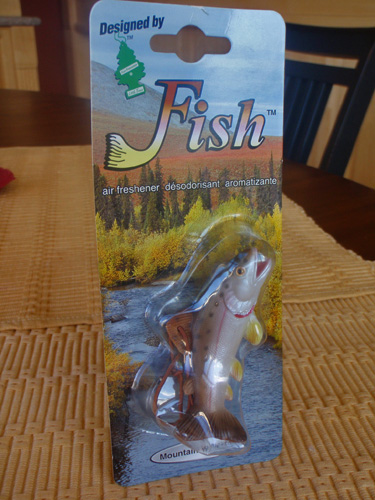
I’m a wee bit of a gear whore, and profess to having a weakness for fishing gadgets. But I also like a good deal. The invoice lists the item as “air fresh trout”, and for $4.63 I figured couldn’t go wrong. Brought to you buy the same manufacturer of the world-renowned line of “Little Tree” air fresheners, this one is simply called “Fish™”. That’s right – Fish air p92607441fresheners: An oxymoron if there ever was one.  As much as I love catching, releasing and sometimes catching and eating fish, the smell is unmistakably…fishy. It doesn’t take an experienced angler to realize that fish are not known for having the most pleasant of odors in the world. In fact, the smell of fish is unpleasant enough to be used when describing house guests that linger past their welcome. Remind yourself of this fact as the relatives from out of town arrive at your house for Christmas this year.

Fish air fresheners, indeed! My first thought was that that the marketing guru behind this product had probably lost his or her job due to this glaring little oversight, but closer inspection of the packaging revealed that “Fish” is apparently not the actual scent, but rather the name given to this particular product line. The actual scent is listed as “Mountain Waterfall”, p9260748which conjures up visions of, well, waterfalls in the mountains. Now I always thought that water, which includes waterfalls, doesn’t really have a scent unless brackish or somehow horribly contaminated, neither of which would seem likely given that this a waterfall in mountains. Apparently I was mistaken because this mountain waterfall does have a detectable scent. To describe the aroma, close your eyes and imagine yourself in a beautiful alpine meadow: In the distance a bubbling brook cascades down the side of a mountain, the mist from which combines with the naturally sweet scent of wildflowers and wafts gently toward you on a light breeze.  It’s nothing like that.

All kidding aside, I have smelled many air fresheners that are much worse than this. One has to admit that seldom does the air freshener smell worse than the odor that one is attempting to mask, but some air “fresheners” are a bit overbearing. Some are downright nauseating. My daughter has one such device hanging from the rear view mirror of her car that is supposed to resemble “Piña Colada”. It’s a sickeningly sweet smell that reminds me of, well, a piña colada. By comparison the little plastic trout from the waterfall in the mountains is really not unpleasant at all, nor is it so overpowering that you will need to drive around with the car window down for the first 2 weeks of ownership before it can be tolerated.

To save you all the trouble, I did a little research and it appears that this particular piece of fishing gear can be found online by using the keywords, “trout air freshener“. However, the search results are misleading as it is mistakenly listed as a “rainbow trout air freshener”, when clearly it is a brown trout air freshener. This sort of technical oversight might go unnoticed by the general public, but discriminating anglers on the quest for a rainbow trout air freshener would surely take note of the inaccuracy.

After three weeks of field testing, I have some solid data to report: The air freshener is not quite up to the task of competing with the combined odors of wet dog, soggy waders and second hand Mexican food that linger in my Jeep. It was determined that a second Air Fresh Trout would be needed to effectively wage battle, but when I went back to the auto parts store to pick up another one they were out of stock (apparently this is a hot item). I considered ordering one online where the price is cheaper, but shipping charges would negate any cost savings, and besides I like to support the local shop when I can. The clerk promised to call me when more inventory arrives, and when it does I’ll let you know if my car takes on the smell of a mountain waterfall, or continues to smell like a brown trout.

In conclusion, I highly recommend you have a few of these on hand for the Holidays, to give as gifts or to hang in your spare bedroom. Remember: Fishing has established limits – so should the duration of visits from out of town house guests: 2 days, tops.

pa070773

Waders and leaking.

Anyone who has taken the time to read the Welcome page of the Unaccomplished Angler knows that I don’t do gear reviews, per se. Well, like so many fishermen are prone to do, I lied. That being said, bar none the single best gear acquisition I’ve made in recent years would have to be my Dan Bailey waders (the Monomaster being a close second). I’d purchased another brand of breathable waders less than a year before seeing these modern marvels in one of the multiple magazines I prescribe to (‘prescribe’ is not a typo), and I knew right away I had to have a pair. Now one might think it a foolish waste of money to buy an expensive pair of waders when a perfectly good and much less expensive pair of waders hangs in the garage. But before you judge me too harshly, let me remind you that behaviors regarding anything related to fly fishing do not fall under the category of “rational.” No, I did not need them. But I wanted them. That’s all the justification I required as I waxed and polished my credit card and marched confidently into All About the Fly to make pa2807741the purchase.

At this point I ran into an unexpected logjam: After 42 years I was shocked to find that most men are taller than me. There were size L and XL to choose from, but they didn’t have my size (apparently they don’t keep children’s waders in stock). Luckily they could order me a pair, and within a week I had a pair of size medium Dan Bailey EZ Zip Guide Waders that fit like a loose-fitting glove. Reminiscent of a little kid with a brand new pair of Ked’s sneakers, I was so enthused that I wore them home from the shop. On the way I stopped at the local grocery store to pick up a few things for dinner, and the cashier apparently really liked my new waders too, because she kept staring at them. Who could blame her – they’re really quite something to behold. But don’t take my word for it – read what the manufacturer has this to say about the merits of the EZ-Zips:

“…a front access RIRI waterproof zipper for exceptional ease on and off, plus the convenience of the zipper for adjusting to vent air for your maximum comfort…Many fishermen roll down the upper portion of traditionally designed waders to cool off or for shallow water wading. Just zip down the zipper and your upper body will cool off.”

This all sounds quite impressive, but I bought them not for the ease of getting them on or off, or for the ability to quickly cool my upper body. No, I bought them for the matter of liquid.

Fishing is all about liquid: From the water in which we stand when wading, which is the same water that floats our boat, to the great amounts of water that falls from the sky in the form of cold rain upon the hoods of insane anglers who find themselves fishing during the winter months when sanepa280775 anglers are huddled around a crackling fire reading books about summer trout fishing. But fishing is also about other liquids – the liquids that float our kidneys: The coffee we drink in the morning as we’re driving to the lake, or for those unenlightened souls who never acquired the taste for grown-up caffeine, the Coke they have with breakfast in camp before hitting the river. During the cold months we may take a break from not catching fish to sit in the cab of a truck with the engine running to thaw our toes and pour a hot cup of something from our thermos. When it’s hot, we may drink water or some variety of other bottled/canned beverages to keep ourselves properly hydrated, or to perhaps drown our sorrows when the fish repeatedly refuse our offerings.

Suffice it to say, beverages factor prominently into the lives of anglers, and what goes in, must come out. And unless you’re body is not functioning properly, sooner or later anglers must relieve themselves. If an angler is of the female gender, the act of relieving oneself is not a simple endeavor and that’s all I’m going to say about that. But if you’re a guy, the task at hand (no pun intended) can be as easy as standing up and letting things flow. However, much of the time we anglers find ourselves swathed in layers of clothing that make the simple act of relieving ourselves a bit more labor intensive. Let’s assume, for the sake of this example, that the fisherman (and it’s OK in this case to say fisherman because I’m referring of course to the men in the listening audience) is wearing the following gear/clothing: Long johns, fleece pants, a fleece jacket and a few other cumbersome layers to restrict upper body movement, waders, and a gore-tex jacket. Maybe some gloves, too. With this laundry list it’s safe to conclude that it’s a cold day. It’s probably raining or perhaps even snowing, and if it isn’t, there’s likely a cold winter breeze blowing. You’re standing thigh-deep in a frigid river, and suddenly your bladder reminds you of the 3 cups of coffee you ingested 2 hours ago. Now, barring a catheter or Adult Depends (which I have considered, mind you), you’ve got two choices: Ignore it or deal with it. If you choose to the former, that’s your decision and you must pay the consequences. But if you’re like me you must deal with the situation, so let’s assume that to be the course of action.

pa280777Now most guys don’t relieve themselves at the first hint of a full bladder–we file the urge away for as long as we can (it’s the same instinct that prevents us from stopping and asking for directions). Afterall, if you don’t maximize the amount of time that your fly is in the water, your chances of catching a fish are greatly diminished, and the odds of catching fish are stacked against you in the first place. So, by the time you admit to yourself that you must do something about the growing discomfort low in your abdomen, you realize you have a problem. Glancing over your shoulder towards shore, you become painfully aware of just how long it’s going to take before you can actually do something about it. You’re 30 feet from the river’s edge. Beyond that it’s another 15 yards of gravel bar before the privacy of some bushes. The current is strong enough that you must choose your steps carefully so as not to loose your footing: A tumble in the icy water would quickly put an end to your day of not catching fish and leave you soaked, which is exactly what you are trying to avoid by getting to shore as quickly as possible. The going is slow, but you make it to water’s edge. Your bladder is barking at you to hurry it up, so you quicken your steps over the gravel bar. You don’t dare break into a run because each step is a careful orchestration of muscle control: Using the right ones while not relaxing certain others. Finally you reach the safety of the bushes, locate a suitable branch on which to lean your fly rod, and commence to disrobe.

The first possible task at hand may be that of removing your gloves. Admittedly, gloves worn while fishing are cumbersome so let’s assume you’re not wearing any, which expedites your mission. Next, you must embark on the adventure of unzipping your rain jacket. With numb fingers (because you weren’t wearing any gloves) this sort of simple dexterity becomes considerably more difficult and the unthinkable happens: The storm flap gets caught in the teeth of the zipper. Now you’ve nearly got a crisis on your hands. To avoid me rambling on unnecessarily, let’s jump ahead to the point at which the train has been backed off the tracks: You successfully remove the jacket and drop it to the ground with careless regard for the exact location. You are now without a waterproof barrier and instantly become aware of this as the driving rain begins to soak your undergarments. The waders must now be lowered to at least waist level (preferably slightly below). Like a stonefly nymph struggling to shed it’s shuck you wriggle and writhe as you attempt to get a hold of the farmer john straps, wasting yet more precious time. Finally the waders are down, followed, hopefully of course, by the fleece pants, long johns and perhaps your favorite Spiderman boxers.This is the point at which you realize just how cold your hands are, and you give forth an audible, high-pitched gasp. The wind reveals its Arctic origins as it bites at your exposed nether regions with a ferocity that takes your breath away. The old bladder is way past panic mode when you finally relax certain muscles and let things flow. “Aaahhhhh….SH#T—!!!“ In your frenzied scramble to remove all layers of clothing, you failed to acknowledge the one Cardinal Rule that all men learn as boys: Don’t pee into the wind. You remember this an instant too late, and in an attempt to minimize the damage you pivot abruptly, sending a stream of heavily pressurized bodily fluid in a wide arch which partially misses your rain jacket that was haphazardly dropped on the ground without regard for certain logistics. With the wind now pounding your backside and the rain drenching you from above, you must wait impatiently for the flow to subside. Those three cups of coffee seem to have transformed into a 3 quarts, and by the time you’ve drained the holding tank, Mother Nature has done a pretty good job of beating the crap out of you.

Now, had you been sporting a pair of the Dan Bailey EZ Zip Guide Waders, all that would’ve been required would have been for you to unzip your jacket, (calmly, I might add because of the confidence that comes from knowing you have plenty of time), then lower the zipper on your waders and, well…you get the idea.

Cooling? Ease of ingress and egress? Riiiiight. If I were in charge of marketing for Dan Bailey I’d have named these the EZ Pee Guy Waders. I suppose there’s a reason I’m not in charge of marketing for them, or any other company.

At any rate, I give these waders two thumbs up. I’ve had them for 4 years (which means I am no longer 42) and they’ve never leaked.

But I have.

pa110782

Newer posts »